

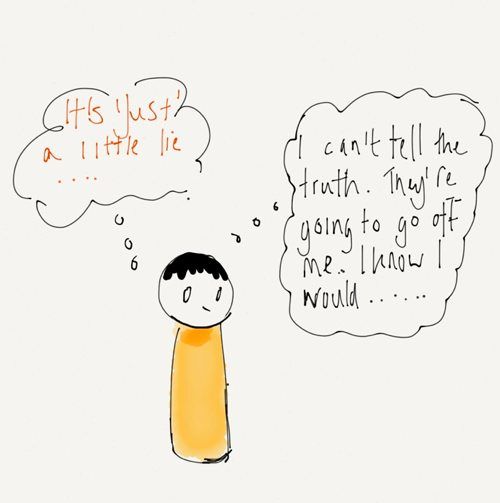
In the early days with the Boyf - I haven't called him that for ages! We've been married a year now! - he asked a couple of questions where I admit, for a few seconds, I felt Oh here we friggin' go! Momentarily, it was tempting to lie or 'dilute' so that I could preserve an image of myself. It's that honeymoon thing where you're under the misguided impression that your partner thinks you're perfect and that you just fell out of the sky with no past.
I would have been living a lie though, plus I knew if I lied I was on a self-sabotage path. Instead, I told him the truth because I was no longer judging myself. I am who I am, eff-ups and all. And by lying, I would have assumed he was perfect and it was just me who was a flawed human being. If the truth was going to cost me the relationship, we weren't supposed to be together. That, and lying would also have been judging him to be like my exes. He didn't deserve that.
Lying is a form of judgment against the recipient. And if we're inclined to be self-critical, our lies are also judgments against ourselves.
Sure, some people lie because they're honesty intolerant like the way some people are with dairy and wheat. Plenty of us, though, misrepresent aspects of ourselves because when we're around people we really want to impress and fit in with, we depend on their validation. When they ask us something about which we already judge ourselves, to delay what we believe to be the outcome of truth (not fitting in, being judged in some way, etc.,) and in responding to panic, we tell a lie we'll later come to regret.
Whether it feels like a 'big' or 'little' 'ineffectual' lie, we decide in that moment that:
1) It's not in our best interests to tell the truth.
2) The other person cannot handle the truth or 'shouldn't' know it.
3) They don't deserve the truth.
Regardless of the size of the lie (which is subjective anyway) and for however long the lie prevails, we make a judgement about that person.
e.g. They will see me as _________ if I tell them my real age / about that thing from the past / who I really am.
Our rationale for lying can even extend to: I'm only telling this lie until they've had a chance to get to know / fall in love with me.
Someone who's cheating on a partner is hardly going to tell us the warts and all truth of the involvement. They judge that we'll either tell 'em to jog on or they judge that we will be okay with the lie (or at the very least that we're malleable).
When humans lie, we project our perception of ourselves onto others or we project a negative reaction or situation that we associate with someone else (possibly ourselves). We determine that this person will behave similarly to what we've predicted. Or we simply deduce that if we tell the truth, it will take us out of the running for whatever we want further down the line or right now.
At the time of lying, it feels like 'one little lie', especially if, after telling the lie, we feel like we're being otherwise truthful.
Unfortunately, every day, or certainly every opportunity, that goes by for us to tell the truth, is another lie told. It might still be the same lie but it's reinforced several or many times. This is very upsetting for the other party who will feel that there were opportunities for the lie to be corrected (or admitted to).
We might lie because in not knowing a person, we don't feel confident about how they will react. Still, that's an insufficient explanation for why the lie prevails. Of course, then we get to know the person too well to tell the truth as the loss seems bigger than at the outset. Oh, the tangled web we weave.
I've heard from people who are lying about (or have dealt with someone who has lied about) their age (claiming that they're younger or older than they are), the existence of children, the number of children, having been married before, still being married, pretending they don't have family or friends (yes, really), claiming someone had died when they hadn't, claiming to be seriously ill, and pretending their divorce has gone through while planning another wedding.
If you've lied to someone about something that basically amounts to misrepresentation, unless you lack a conscience and empathy, you're likely aware of the personal toll of living a lie. It's just not good for your sense of self.
Whether you got caught out or eventually admitted to it, you're also likely aware of how badly a person can take being lied to, even if you didn't have shady intentions. Sometimes we feel 'better' about the lie because we're not lying to gain an apparent advantage per se. In our minds, we're lying because we're so afraid of being ourselves and what that means.
The thing is, humans have associations with everything. I say "fish", you might say "chips" and a person hears "lie" and might associate it with various negative experiences. They lose confidence in you, and it can take time to recover the trust.
It's also safe to say that someone who's mistreating you will take your lie and use it as a blanket justification for subsequent or even previous treatment. it's as if, "I knew there must be a good reason for why I was mistreating you! My goodness! My shady spidey sense must have known you were lying." No, they didn't!
If you're misrepresenting yourself to someone with whom you want to forge a relationship, romantic or otherwise, you're setting yourself up for pain. Without trust, there's no relationship. It can also force a person to ponder what else you've been lying about.
You have to question whether this lie is worth it.
Is lying worth the anxiety? Is lying worth what may amount to holding a person under false pretenses? How would you feel [about being lied to]? Is the lie an accurate representation of your character?
It's easy to say that the lie is 'small' but it might be big in the other person's eyes, simply because they realise that you don't trust them. They believe that you perceive them in a particular way.
Most people who I've spoken to regarding lying got themselves into a pickle out of panic. They don't go around lying to people all of the time and regret taking a detour from who they are due to embarrassment or even shame about an aspect of their lives. Some let desperation and fear of missing out on a relationship block the truth, only to spend the entire relationship feeling unseen.
If you're lying about something, the sooner you tell the truth, the better. Be honest about why you lied - both with yourself and the other party.
Lies are like comb-overs, an attempt at disguising the truth where you may fool some but you'll always be fooling yourself. A relationship built on mutual respect, care, trust and eventually love has no place for misrepresentation.
Your thoughts?

 Add to favorites


Amazing insight Nat: when you are fooling others, the first one you’re fooling is yourself.
“The first principle is that you must not fool yourself and you are the easiest person to fool.”
Richard P. Feynman
Oh, goodness, Teddie, I, as I sometimes do, found myself searching for a like button. But, really, I very much enjoyed that quote.
@Teddie..Good to meet another Feynman fan.
As always, excellent post! I agree wholeheartedly that honest is the best policy. I tend to be painfully honest at the beginning of any meeting. Of course, I don’t reveal the deepest darkest secrets but I give a fair representation of myself in terms of who I am and what I will and won’t stand for.
That way, that person can make an informed decision as to whether or not they want to deal with me and I expect the same. That is why I tend to adopt and all or nothing type of approach when I decide to let people out of my life because I give people an opportunity to tell me the truth. When they don’t, I tend to flush and don’t look back. Don’t get me wrong, because of past issues, it often takes me awhile to get there – especially when I fall for someone, but when I do, I truly don’t look back.
Honesty is the way to go! I fully agree with you & your comments 🙂
Take off the smile…it’s not funny!!
People don’t always smile because something is funny, it could be agreeing or just happiness that someone gets their own thoughts etc?
Mytimeisnow, I couldn’t agree more with you on this!
I broke an engagement several months ago because my former fiance was a complete liar! He lied about how many times he’d been divorced, said he was already divorced (Had not even filed!) when we met, and on and on. For a year and a half it was all lies but I eventually figured things out after so much simply did not add up. A little sleuthing on the internet investigating only public records blew me away!
He has yet to address any of his repeated, massive lies (He denied nothing I found out about him!) and I am sure he is not telling any new potential partners about his dubious, dishonest history. I feel like I dodged a bullet from a sociopath!
He has a new personal ad out there- he is looking for someone ‘honest’! Wow! Just wow!
Mary
I do sympathise with you..but at the same time, I cannot help it. He is looking for someone honest? Hahahahaha!
Good for you in your sleuthing!
I really hate this loss of “innocence” since the AC. Trust me, I was anything but “innocent” in many ways but I still basically trusted people. I really don’t want to have to go all Columbo on everyone’s ass. I guess I was lucky that I didn’t experience the fall out till I was nearly 50. I may have met some ACs earlier on but I had so many more options, I just naturally flushed them. Maybe, a little heartache and regret but I was always on a roll… I think once the “Last Chance Saloon” thinking took hold with this last AC, I really got it from reading BR and now it is hard not to be looking for all the amber and red flags. F’ing exhausting and sad there are so many of them.
I think I was honest in the past because I thought I was all that but my truth/life is less appealing to me now so I will definitely take this post under advisement!
This isn’t as hypocritical as it may seem. Habitual liars need honest people in their lives in order to make the lying game work. Only genuinely honest women/men are likely to believe in them and trust them, at least initially.
It’s funny, whenever I see dating profiles/personals where people talk about “honesty” I take it as a red flag. Shouldn’t honesty be a default value that everyone desires?
Obviously they project their own capacity for dishonesty onto others and it disturbs them.
What a creep.
Infinite,
You are so right!
I think the same applies when someone claims to be a great friend.
Unfortunately honesty becomes an issue when your trust has been broken.
Asking for honesty, though, is a bit pointless. An honest person will think it’s obvious that you are honest in a relationship, so why ask; a dishonest person may see the sign of a vulnerable target.
Hear, hear…I don’t understand people who lie, it’s worthless & it’s a sickness! On the other hand I never lie & I know it gets me into trouble; I have this knack for catching liars out in the end. And this lovely angel just does not understand why I have lost all trust! I am so sick of been taken for a joke!!!
when the stories change, when you ask a month later the same question or the facts or whatever change you start to think it’s you who is going mad!! But if you write it down, on paper, yeah, you come back & burn their fingers!
My entire 18 year marriage was based on lie after lie. I should have realized it with his first “white lie” of his age when we first met. There were plenty of others to choose from. It ended with him lying about a 6 month affair.
AngelicBlue,
I am sorry to hear about all the betrayal you experienced from your exhusband.
My exH also told a white lie about his age when we met (by only one year). There were many other lies after that, too. He is now in counselling with one of the main goals of becoming a more honest, truthful person. He lent me a book he bought “the Liar in Your Life” (can’t remember the author) and its very interesting reading the research on how often people tell white lies and bigger lies. One study showed a huge number of lies people tell others they have just met during a ten minute initial conversation. Since my exH and I are in the process of getting back together, I am glad he is working on his truthfulness. I am working on this too, in my own life.
Nat-You must be reading my mind. My relationship with my ex that I ended at the end of April was all based on lies:
*He lied about his age on Match (He’s older than he claims) and I didn’t know until way later on but I let it go. Big mistake-one lie lead to even bigger ones-see below.
*He lied about cheating on me & dating other women on Match.com when I confronted him (one date occurred when I was on vacation with my family and he told me he couldn’t go because he had to take care of his son-I found out on his Facebook page that he went on a date with the girl the weekend I was away-photos of flowers he gave her were a dead giveaway).
*He lied about allegedly having his son every weekend the last 5 months of our relationship-he told me his ex-wife’s mom had cancer and the ex-wife couldn’t take care if the son). I recently found out the mom never had cancer-She is just fine. I believe he was dating other women. For how long? I will never know.
*I’ve also found out as recent as last week that he is lying to the girl he is currently dating who he cheated on me with that he is dating others along with her. He is also lying about where he works.
*The man is a sick person. I am so thankful I caught him when I did.
Good for you Movingonin2013. That guy sounds like a giant head case and a total flush. I’ve encountered the “lying about his age” thing numerous times. Its wacky. They say they are 48 online when they are really 52. WTF is the diff? When they fess up to the fact they lied about their age, I’m supposed to then believe they are “honest”? It’s like c’mon dude, you are with a 54 yro woman and you think lying about your age is going to get you the 20-something. Sometimes I go through the drill: So you lied about your age and now I’m supposed to believe that you are single? On what basis would I believe you? His response is usually something to the effect that I lied but then I told you the truth. That’s when I call for the check, pay my share, and leave him sitting there wondering what just happened. It just leaves me scratching my head. Lying about their age is simply stupid.
I met up with someone via a dating site who advertised himself as 39 yet he was actually 45. When I called him on it, he explained it thusly; “It opens up a whole dating pool of women who would otherwise not be available to me.” Clearly he’s hoping that honesty matters less to any potential dates than age does. What does it matter when you only need someone to suspend disbelief long enough to get them to drop their knickers?
It was at that point I realised a lot of blokes see online dating as an online shopping catalogue with stock changing daily. Nice.
@Ms. Determined-
I know that is EXACTLY how my ex is operating now. He is still “dating” (and I put that in quotes because I know he’s been dating other women that he’s met on Match.com in addition to her) the woman he cheated on me with. This girl knows that my ex cheated on me with her, yet she continues to stay with him,even though there are many red flags on the internet about him. I know he will do the same thing to her that he did to me someday. This is because I found out during my sleuthing that he cheated on his ex-wife.
My ex is currently stating that he is 38 on his profile, but he is actually 41. It’s really sad to see someone at his age still acting the way he does. On top of this, he has a very sweet son who is probably wondering why his daddy has all these women coming in and out of his lives.
I tell myself that all these lies are really going to get him in trouble someday. Karma will get him back. It may not be today. It may not be tomorrow. But it will happen.
hows about the one who lies about cheating on you and then tells you we should be dating others and backs this hurt up with i was being honest
Oh boy, I know that one.
Then there’s the time he was invited out to Sunday lunch by three women.
‘What was the big secret?’
‘I forgot to tell you.’
‘Were they surprised to learn you were in a relationship?’
‘I forgot to tell them.”
@runnergirl-thanks! It’s been an emotional roller coaster for me in terms of healing my wounds, but each day is a step forward to getting better!
I agree with you-Why would people lie about their age?? Where will that get them? Sooner or later, the other person is going to find out. If they are lying about something like this, you can imagine the endless possibilities of other things in their lives that they are lying about.
that is exactly why they lie about their age: they are not planning on staying with you long enough for you to find out their real age, they just want some sex but can`t admit that either because the`d be no takers.
@sushi-
You spell it out perfectly!!
It’s sad that these types of men put on a facade and nice people like us fall into their trap of lies.
yes and some people do it over and over
I want to chime in on the lying about age thing… A lot of dating sites/searches have filters and will only match you within a certain age range. My last 2 relationships were both men I met in real life and one is 10 years younger than I and the other 15 years younger. (I’m in my 50s so we’re not talking about cradle robbing!) So, yes, I did fudge a couple of years off of my age so that the dating pool will include men who have found me completely dateable in real life. I don’t see this as a deal breaker unless it’s for more nefarious reasons or it’s part of a pattern.
I wonder if this increase in online dating is making things worse. Online daters who have no intention of getting serious – and even if they arent liars in the rest of their lives – why bother with the truth if you already know that there are lots of other ‘matches’ and you dont want anything serious, you just want the dating game. Right?
This guy sounds like a sociopath but in the online world women still go out with him. Brrr.
@Suki-
Yes-My ex is the perfect definition of a sociopath.
I decided to start online dating with the intention of what many other people want and are lookng for-And that was to find love. After this experience and my previous experience with a different ex-boyfriend, my personal conclusion is that the men I’ve met are only looking to play with emotions and have no intention to have a serious long term relationship.
It’s unfortunate that when you are upfront with them in what your intentions are from the very beginning, they mirror them with the same sentiments and then down the road (they tell you they love you, want to have babies with you, drive around neighborhoods to look at dream homes we wanted to live in), their true colors come out with all lies, you are the one who is left hurt and brokenhearted and you have to be the one to pick up the pieces while the other person moves on like you meant nothing to them.
My last boyfriend said he was 38 when he was actually 45. It felt a bit funny but I didnt give much attention to that as it was early days. He turned out to be an EUM, then one day he just disappeared. After I tried to contact him a couple of times he broke up with me through Facebook.
I can’t avoid thinking that there must have been other things he lied about as he was always so busy, never called just texted and then simply vanished.
Anna,
I am sorry but your ex sounds like a coward, breaking up over Facebook. I heard the “so busy” excuse so often with the exMM. Turned out the reason he was so busy was that he was juggling three women – his wife and two OWs (one of which was me). I am happy not to be included in that “busy-ness” anymore! Perhaps your ex was so busy for similar reasons? Sorry you had to go through that inconsiderate breakup. It does sound like you may be better off without him.
@Mary-your ex sounds so similar to mine, except we were talking about marriage. I thank God everyday that we never got engaged. I, too, did a lot of Internet sleuthing and found things out about him. The man I dated was a definite sociopath. Scary that it took me 1 1/2 years to figure it all out, but so happy I did. Can’t imagine the additional infidelities that would have occurred.
Yes! It was a year and a half when my relationship began to unravel also. He had talked about getting married and something inside me said not just yet. I thank the universe for both of us not making such a disastrous mistake. It was hurtful enough already to experience what we did!
We have to consider the cumulative effect of lies also. In my case, the big lie brought into question a few smaller ones, those in turn brought up others. And like a house of cards my trust of 38 years was brought to its knees. Now when this person tells me the sky is blue my first instinct is disbelief. Even if by some odd chance we are ever together again I will never trust a word out of his mouth….which isn’t a good basis for a relationship.
Sorry for you..I understand where you are coming from. Try & keep your sanity!
I have come to learn that people lie because they love their own ego more than they love you.
Excellent point!
Yana, I agree! The exMM used to lie to everyone, and would keep up the lie despite hard evidence that he was speaking absolute rubbish (for example he said he was home napping when his phone locating program he shared with me placed him at a movie theatre). He claimed he lied because he “didn’t want to hurt anyone” or “I didn’t think you/she could handle the truth”. Your explanation is much more likely – he didn’t lie because he loved me/his wife so much that he didn’t want to hurt us. He just loved himself so much that he wanted to get away with as much as possible. It’s freeing NOT to be involved with the whole lying gig anymore, since of course *I* was lying too during the affair, and hurting his wife though my own actions. Never again!
Yes Learner, that was the most difficult fact to face…I was lying to everybody as long as I stayed in the role of the OW. I’m still working on forgiving myself for lying to everybody.
Mostly I am still working on forgiving myself for lying to me. I got the drip fed “truth” because he didn’t want to upset me. Yeah, right. If the truth is upsetting, there is a reason. Overcoming the lies has been a major task. That’s why I won’t even entertain a guy who thinks lying about his age is okay. At 50-something, we are all old. There is no point in lying about it. Lies end up mattering in a big way.
Runner,
Yes, it does take some time to forgive ourselves, doesn’t it? When we behaved outside of our values for so long, I think we had to suppress our real selves just so we could stay involved. I keep thinking I have forgiven myself for lying to myself, but then why do I still think about my time as an OW so often? There is still information there that needs to be processed, even though the focus should be on ourselves as individuals, not just as “former OWs”. You are further along the OW-no-longer path than I am. Do you have any tips on how to forgive ourselves for lying to ourselves and others? Congrats on the new furry family member btw <3
Learner- To my knowledge, I haven’t been an OW. Thus, I’m hesitant to give advice on the healing process. Something in your post, though, struck a chord:
“not just as “former OWs” ”
Your wording here may be a part of what’s holding you back as it reads as if you’re labeling yourself. My opinion only and I’m no therapist, but labels keep us in a box. You’re bigger than your mistakes. You got involved with a married man at one time in your life and are paying some pretty heavy consequences. Ok. But is that all there is to you? of course not! The same woman who was once involved with a MM is also the same woman who would never do that again. You have a sense of humor, hobbies, opinions on the political situation in your country, etc. You would probably give the shirt off your back to somebody who truly needed it! Your past experiences give you such a wonderful opportunity to reach out to women who want to leave behind the OW life but are scared to reach out for help out of fear of being judged and condemned. You can relate and help them in ways that I cannot.
You’re too big, too awesome to be stuck in a box. So go right now to the drawer, get the scissors and box cutter and cut off the label and cut a door in the box to crawl through and stand up and stretch. The world awaits you!
Rosie,
Thank you for your insightful response. You are right, of course, that our mistakes do not define us. I need to give the “former OW” role less space in my brain and get on with being me, Learner. You put a positive spin on how even the former OW experience can be used to help others – something I have tried to do already. Natalie had a prior post about being pigeon-holed into certain roles, and I seem to be doing that to myself. I am taking your advice right now, cutting the label off, cutting a hole in that box, standing up and stretching. It feels good! Thank you again xo
I thank you too Rosie for your response. I think you are right. I’ve worn the scarlet “A” banner/label long enough and paid the price. It’s tattered and torn and time it’s sent to the trash bin. Learner, I’d say we burn that label together.
Lesson learned: Telling little lies and big lies can end up mattering in a very big way. There’s no way to get involved with an attached guy without lying! Dead end.
Runner and Rosie,
Yes, I would love to burn the scarlet A with you runner. And the scarlet L for liar, too. Detaching now from the attached men, AND from the OW label. How liberating!
He lied because he did not want to deal with the consequences of telling you the truth–‘deceit’ and ‘omission’ are their middle names.
The MM did everything on a ‘need to know’ basis. We once spent 11 hours in bed, hanging out, making love, then went dancing. At the end of the evening he told me he and his wife were going to try counseling to save the marriage.
How on earth could a sentient being do that? Dodger.
Swissmiss,
Yeah, those middle names seem to fit. Your experience also speaks to the ability some people have to compartmentalize. I don’t want to be stuck in some deceiving, omitting MMs compartment ever again. Aren’t you glad we got the heck out of Dodge?
Completely. Totally. 1000%. If we were pioneer stock, we’d have saddled up and left ’em covered in dust, while our horses gave a meaningful flick of their tails.
What a place that was, huh? Surreal.
I’ve lived the “truth by omission”, lived by the “need to know basis”. We are pioneer stock. We’ve saddled up and left them covered in dust and horseshit.
Yep, it was surreal. It is sometimes hard to figure out how I believed a cheater was honest…cos he told me so!
Swissmiss and runnergirl,
Saddling up right now! Cue meaningful flick of horses’ tails. Horses never lie, they know what’s what 🙂 Love it!
Off topic I know, but I love that Nat gives us a new post to ponder on a Friday night. I think it’s to keep those wandering minds busy at the start of the weekend. A hard time if you are living NC. Thanks Nat, we appreciate all of your hard work.
Lies? I’ve been told them and I’ve told them. I hold my hands up. Didn’t get me anywhere, just held off the inevitable for more wasted life moments. I let myself down by telling them OR believing them…
The worst lies were the ones I told myself. Now I ask myself out loud, Is that or this really the truth? I learned that from reading Katie Byron.
Some of the statements we make to ourselves and others are vague perseverances with no substance. It’s empowering to have a little dig around and dispel some habitual thoughts.
I’m learning to tell all in my new relationship, I feel safe enough to let myself out, bit by bit, monster heads and all. It’s not always easy but I’ve never felt judged and the learning and the growing and the understanding is the sweetest thing of all. I’m not skipping around love meadows like PollyAnna, it IS hard sometimes but knowing that he and I come to rest in a newer more informed place is teaching me to be much more emotionally available. I am learning and putting into practise all my BR qualifications.
I am becoming who I would like to be.
Seamtress,
Your comment is inspiring. Thanks for sharing about being able to trust yourself and your partner and how much better it feels to be emotionally available.
@theseamstress-
You are dead on:
“Off topic I know, but I love that Nat gives us a new post to ponder on a Friday night. I think it’s to keep those wandering minds busy at the start of the weekend.”
This is the first weekend since my breakup with my ex a couple of months ago that I am spending it on my own. Every weekend since the breakup, I’ve surrounded myself with friends and family or I’ve been on business trips.
This weekend, I will surround myself (albeit electronically) with friends like Baggage Reclaim and the readers who have experienced what I went through. So I guess in some ways I really am not alone!
Thanks Nat, for always being there for us!
I had a bf who lied about his age, he deducted 5 years. It mattered a lot. When I found out I was surprised at how much I cared, not about his age at all, but about the lie.
They just don’t get it! They don’t understand that once they’ve crossed that line, it is virtually impossible to go back!
This is very true. I’ve been lied to a lot in recent relationships. I am quite honest and straightforward, yet I tend to get together with people that tell whoppers and small ones and all the ones in between [including the classic ‘btw i’m married’ said a few weeks into a very intense relationship when I was much younger and when you dont really expect that people are married. He was in my friends’ network and no one knew, he was hiding it from everyone].
I think the lies are told for a lot of reasons like Nat said – fear of confrontation, of taking responsibility, shame, resentment at the other person (you judge me so i just wont’ tell you so there – its inherently childish). It takes away the other person’s freedom, it puts the liar in a position of power. It breaks trust, and the fallout is always much worse than whatever was in the lie.
I dont know why people do it. From my own perspective – I dont know why I tend to find people who lie. Its possible that my sort of warts-and-all openness makes other people uncomfortable. They dont take the warts-and-all view of themselves and others so they dont want to be truthful? I dont know.
The liars also come in different stripes. Theres the truly narcy ones who will say they value ‘honesty’ and make a big deal of it [‘I dont lie, I just say things that arent true’]. My ex didnt see the difference between a lie and say a miscalculation. E.g. after lying to me regularly, he once called me a *&^%$# liar [yelling in public] because I had told him we didnt have time to do x so I ‘made’ him hurry and then we made it to our deadline with 10 mins to spare. Ergo, I’m a liar! But he’s not a liar because he values honesty and only ‘says things that arent true’. Phew. What do you do if you and the other person dont even share the same conception of the truth?
Dont be with liars. They dont change, theyre weak, theyre not responsible with your heart.
Oh God I laughed so hard at this. “I don’t lie, I just say things that aren’t true.” Hahahahahahaha!!!!!!!!!!!
Suki and Wiser- “I don’t lie, I just say things that aren’t true.” This had me in stitches! I’m sorry, Suki, as, in a way, my laughing came at your expense but this line cracked me up!!! I couldn’t stop laughing!
I am guilty of being the one to believe all the lies. In hindsight it all seems SO clear – the signs were there all along.
Him saying he had kissed two girls on New Years Eve when he was supposedly in love with me and then saying he was “joking” (ha.ha.)
Then he told me he had had a girlfriend before (when he hadn’t) and instead of throwing it in his face I just thought “awwww”.
There were times when he would disappear on me or invite all these girls for coffee and dinner/movie because “I happen to have many female friends”.
But I never once questioned it.
The lies were there and every time I found out, I ALWAYS gave him the benefit of the doubt! His plan worked out perfectly.
Never again though. Now alarm bells go off every time someone mentions something which is a bit off, I’m out.
I still kick myself for the lies I told and how I watered down my expectations in order to ‘win’ my ex. If I’d been honest at the start and not entered into a casual (but secretly hoping to upgrade) relationship then I would have saved myself a load of grief which I’m still dealing with now.
I re-entered the dating scene once I’d decided that I needed/wanted a ‘proper’ relationship and that casual wasn’t my thing. I’ve been with my current boyf’ for nearly 2 years now and can see how by telling the truth from the get go has cultivated a real and organic relationship. No more lying for me. It’s just not worth the aggravation!
With an ex from several years ago, I told many, many lies. I just made shit up as I went.
Whatever sounded better in my head, based on how I could manipulate him, I said, regardless of how, if at all close, to reality it was.
He bought it. Sort of. If he was even paying attention. Turns out this particular man had some secrets of his own up his sleeve, or on his computer rather. He was an avid porn addict.
On the first date with my most recent ex I lied. I lied about tiny details that did not permit lying (not that anything does except perhaps in the most extreme of situations). He had asked me how I had met a mutual friend. I lied and said it had been through someone else we both knew.
I really had met said mutual friend through one of my girlfriend’s at the time who had previously had some sort of thing with my ex. I didn’t want to make my ex uncomfortable. I didn’t want him to do anything to prevent calling me for that second date. That went completely out the window when I eventually cut contact.
The ex told these little white lies too. I could tell. We didn’t want to make each other feel uncomfortable in certain ways, jeopardize the tryst (with the truth?!), or lose a footing with power. So we lied. And it all crumbled. It’s hard to tell the truth and, yes, so damned uncomfortable, but it is so important.
There is no other way toward a healthy relationship that works. If the truth is not stated and there is no commitment to it, both parties will be miserable overall (even if it’s repressed misery) and the dynamic will crumble by eroding further and further each day that the truth is avoided.
That said, fast forward a year and some months later, and I am alarmed at the fluidity with which I lie to make situations easier, avoid conflict or just because I’m physically tired.
My father is a pathological lier. And though I love him, my grandfather whom I live with, lies when he gets angry and scared. It’s a family dynamic and habit I picked up that I am learning to shed.
It feels vulnerable and scary to commit to the truth. It feels like being me and putting myself out there in a very scary world full of rabid dogs waiting to attack.
I lie because I am neurotic and scared. I think lying will make it better, but it makes everything more complicated and broken in the long run.
But I’m wondering, if a man asks you a question and you are tempted to lie, because you are ashamed of something you did or think they might reject you, wouldn’t it be ok just to say something like “I’m not comfortable answering that” or “Maybe we can talk about that later when we know each other better” or “Yes I’ve dated others before you, but don’t really want to share details.” I mean, at least that’s an honest answer, right? Sometimes guys ask you things that they don’t really have a right to know.
Oregongirl,
I think it’s anyone’s right not to answer a question that one is not comfortable answering just yet. That sounds honest to me. The person asking the question would have to be respectful and accept it. The downside may be that they could imagine something that may be “worse” than the truth. I guess it’s a calculated risk you would have to take.
I agree, with you oregongirl. To me it’s been a red flag when a guy asks me about the past guys I have dated. It’s really none of their business. When I have said something it has come back to bite me in an argument with an ex
AC. To me it’s setting a boundary. And learning if I am going to trust this person I am with to give them some of the things I hold dear to me or about me. I have learned that the first person that lies, is me lying to myself that an EUM/AC’s behavior is ok, when it’s not and I accept it for fear he won’t like me or whatever. If I listened to my gut at the very beginning of the last relationship I was in I in, I would have avoided two years of constant pain. With the AC being the victim, according to him to justify, cheating, lying, and verbal abuse.
I’m going to start the dating scene soon, I’m finally open to it, and I believe healed from my last relationship and a whole lot wiser
Peanut,
I agree with your last sentence. Have you tried anything to turn this around to become more truthful, even when it makes you feel vulnerable? It’s something I am working on right now in my own life, and it helps me to feel better about myself.
My father was a pathological liar. No remorse, never admitting any lies, ever, even if you caught him in the act. Only more lies until you wondered if you were in indeed crazy like he insisted. He was a pro. Now, my biggest trigger is being lied to. It feels like a betrayal I can’t ever get past. I just can’t. It becomes the biggest voice in the relationship and I doubt everything that’s being said or ever been said by them. As Nat said, a relationship without trust just can’t work so it eventually crumbles. If a man lies to me, even if it’s small I completely lose faith in him and respect for him. I used to tell the truth about myself without hesitation because I didn’t feel like a lost cause. It wasn’t until my last 6 month budding relationship ended did I feel like me being me and admitting who I was could make someone leave. He asked me to tell him more about myself and why I was guarded, what had happened in my life to make me protect myself. He said he wanted me to open up and talk to him. I did. Without huge detail I told him my father had betrayed me in numerous ways and that I had been in an abusive relationship with a man that left me guarded. He dumped me about two weeks later. I felt tricked. I felt more in love with other people, but this one hurt more. I felt not good enough and set up. I’m past it now, don’t give that rat the time of day when I see him, and no longer have him up on a pedestal but the lingering effect was me feeling insecure about admitting who I am. I don’t tell too much about myself these days, but someday I hope to be able to show myself, warts and all and still be loved.
Awh, Selkie, you certainly deserve to be loved.
Selkie,
That man sounds a bit judgemental to me. You gave him the gift of honesty, opened yourself up to him, and he left. We all have warts and deserve to be loved regardless! The right person for you WILL accept and love the real you. All of you. Hugs xo
Selkie,
I think it`s perfectly reasonable to lose trust in someone after just one lie and I think that the fact that this is your trigger is the good that came out of the pain you father dished out your way.This man betrayed your trust because he apparently wasn`t asking those questions to get to know you better or because he was trying to deepen his relationship with you in a positive way. That doesn`t mean you are not good enough, you are far too good for him. Based on what I know about you from your comments here- I would feel very lucky to meet a man who has your qualities. Good riddance to him.
Thank you all. It was a lesson though, in some ways. I missed red flags and didn’t trust my gut on how I felt, which was uncomfortable and confused by him much of the time. He was a step up from the ex abuser and also from the ex pot dealing alcoholic so I think my ‘good guy’ meter wasn’t calibrated correctly. I’m still learning and calibrating. Live, learn, and let go, right?
Selkie, so sorry this happened. I, apparently have the same father as you…thus we must be sisters! I’m with you totally with regards to even the tiniest lie. I haven’t had the opportunity to open up to a guy but I have felt set up by perfect strangers who seem to want to dig into my personal life. I stick to the line that the time we are together is about us in the present, not about our ex’s. That seems to work and shuts down the ex convo. Is all I want to know about him is that he is not attached or married and that I’m not a rebound. I’m not attached or married or on the rebound. That’s it. We are not defined by our past or our lying fathers. I would be hard pressed to discuss anything remotely deep with someone after 6 months. My deeply abusive past does not define my happy, comfortable present. You will be able to show your warts and all and still be loved. We are not our pasts. And we only need to discuss the past abuse with our trusted therapists. That’s it.
Selkie, so sorry. A friend of mine is going through something like this. Though, she found things about her bf that is making her question things. Outright lies more than anything. And i said to her that it would be great to be able to bare all warts and all with a person trusted in a relationship.
But, in many scenarios it doesn’t always happen. I guess that’s why i keep reading here to let people unfold. Have been sharing links from here to her.
In my past i have always tried to (Before i learned that actually no one needs to know everything little thing – shoot there are things mum doesn’t know, and she knows me fully! lol), and like you it hurt when turned around and used against you.
But, i wanted to say, thank you. You will meet an amazing person just for you one day 🙂 It is amazing an brave to be able to open up.
In your own time of course, i always clam up when people try to coax things out of me. I freeze even more.
Trying to re-learn however. And great suggestions from someone before, to say if uncomfortable and answer when ready. That is of knowing own boundaries hey.
>>> I stick to the line that the time we are together is about us in the present, not about our ex’s. That seems to work and shuts down the ex convo. Is all I want to know about him is that he is not attached or married and that I’m not a rebound. I’m not attached or married or on the rebound. That’s it.<<<
Copied, pasted and using as i start dating again. Slowly relearning loads.
I wanted to throw out there that I never caught my ex (who I can happily say I am FINALLY completely over – this summer feels like I am alive again – whoop!)in an actual lie. But I did catch him in MANY half-truths or completely omitting facts which over time becomes just as bad as big fat lies. The “I can’t make it home for dinner as so-and-so had an awful day’ actually meant “I’d rather go drinking with my buddies than spend time with you, but I want to look like I’m a good guy” or finding out after 18 months apart and the divorce that he’d been using drugs for at least 7 years (WHAT? I guess that explains a lot of the crazy drama!). Or the classic time when he said he was at work but I bumped into him at a local pub 7pm after he had had been there since 11am to watch some games, and it became MY fault for spying on him.
Lucky me to be free of that! Good luck to the next one to fall for the charms that disappear into self centered a$$-clownery. But it’s not going to be me! May take some time to teach an old dog new tricks, but I got there! Thanks Nat and everyone else on this site for helping me along my journey!
Such a great, and timely post! My ex AC has recently contacted me. I wasnt entertaining him. He would txt, i’d read, but wouldnt respond.
He told me he was miserable w/o me, and even went to this long weekend ‘self help’ retreat that I tried convincing him to go to while together. He refused. I had actually experienced it myself 1 1/2 yrs ago and it really had a positive impact on my life, my self esteem, everything.
Because I wouldnt entertain what I thought was probably the same insincere attempt, and he knew “i let him go”, he wanted to move on and do the same. He txt me this past WE during the retreat, told me he didnt blame me for not talking to him cause he was a horrible, miserable person. Thanked me for trying to get him to go, and let me know how grateful he was and told me he’d always love me, and understood if i never wanted to talk to him. But that if i did, he would never be “inauthentic” w me ever again.
The last couple of days we’ve talked. Hes been super positive and kind. Telling me every day he loves me. Definately very different from what i was used to. And because I’ve experienced it myself, i believe him. Even his family is saying they cant believe the impact it had on him.
Ok. The thing is. This person has caused me pain in the past. I couldnt trust him. And although i do believe hes being sincere, i cant forget. Not completely. I can forgive him, and be happy for him. But… I dunno… BR and all the work I’ve done to move on… Im scared to try.
“we’ve communicated more and better in the past few days than we did in 8 yrs” is what he said. I agree. But!! Grrr! Lol… Im feeling that it’s too late. We broke up for 10 months, he tried contacting me via txt a few times (he said he was putting feelers out there, cause he knew I was fed up, and didnt want to keep getting shot down).
Im not sure what to do. And I know hes already told his family that we’re in touch and is putting his best foot forward.
Im so confused. Ladies… What would you do? I’d love to hear your thoughts on this. Thanks 🙂
Demke- It sounds as if you are moving on and want to keep moving. If this interpretation is accurate, I believe it would be a step backward to try again. Someone who’s been working on herself for a while is going to be in a different place from someone who’s just starting out. You’re in two different places and to meet in the middle requires you to walk backwards.
You said it all yourself! “Im scared to try.”
Of course you can forgive but forgetting is something else. I am probably a lot older than you and I can tell you every time I did not listen to my ‘inner voice’ warning me, I have regretted it. (I was married for 26 years till he got a girlfriend who thought he was rich! And of course he let her think that! LOL!)
If you do chose to see him, please, please do not jump into anything quickly. I’ve known men who can come back and maintain decent behavior for a while but, inevitably, it eventually starts all over again.
I really believe if I was in your situation I’d walk away but only you can make that decision. There just may be someone wonderful out there. And even if there isn’t right away, it is still better than a broken heart- all over again.
I’ve been engaged twice since my divorce and I am determined not to “settle”! I an very cautious now. You, I, and all of us deserve the best!
I’ve just starting communicating with what I think is a really good guy. We’ll see. But I KNOW I am fine by myself also!
I wish you the best!
Demke,
Someone cannot make a life change after one retreat. Is this guy wanting to do some serious counseling?
Forgive me, but I don’t know your story, could you please give a brief summary? It will be easier to respond.
Demke
What do you mean by contact? Did he text you? Cos that’s low risk and lazy.have you met him? Is it realistic to say you love someone you haven’t seen for ten months? Is it right to dump his feelings on you when you’re not in a relationship? What is he offering?
It’s all very well to get mushy at a retreat but what happens when he gets back to real life.
I’ve been thinking about this myself. I trusted my boyfriend and pretty much out of the blue he broke up with me. If he came back and proposed would I be wondering whether he would leave me at the altar, out of the blue? It’s not worth the stress!
grace,
I would be wondering that. I think what Natalie says, ” don`t let anyone reject you more than once”is what you are doing exactly.
Demke – I’m not sure that I can say this without sounding harsh – I don’t want to, so please forgive me if I do.
My son’s dad really HAS changed in lots of ways, he’s tried and tried to be reliable, honest and to deal with things instead of running away from them. What’s become apparent recently, however, is that if things are hard it’s very very easy for him to slip back into a pattern where he behaves unfairly towards me. Which is why we don’t talk anymore.
Our dynamic is screwed and while I interact with him it’s too easy for both of us to return to those easy-but-terrible roles we had before.
If this dude was an AC to you but really has changed, then imo in the interests of his spiritual development and furthering the change, you should let him go. I tend to think that dynamics are great big unwieldy things and if you know that it’s easy to be a tosser with someone, you’ll always have to fight and struggle against being a tosser. On top of the fight and struggle to just be different and do things differently.
I’d leave it, I really would. If you want the best for him and you really want him to change and grow and live his life in a better way, you won’t want to hold him back from that.
Demke, I’m going to try and be mild and impartial over here but
UNDER NO FUCKING CIRCUMSTANCES GET BACK WITH THIS GUY.
It doesn’t matter whether he thinks he’s changed (of COURSE he’s going to say that) or his family thinks he’s changed (who told you that, him, or his family?) or the experience seems to have changed him (a two day retreat has erased decades of assholery? And a year and a half later he’s trying to get over you? Texting you from the retreat? Hot tip dumbguy, don’t text like the total AC you are from the retreat PAY ATTENTION TO WHAT YOU’RE BEING TAUGHT THERE you only have 48 hours to take it in Is he for fucking real? How about just not being an asshole in the first place?)
Even if he has changed, there is a massive reason not to get back together with this guy.
Because he will still be him.
He will still be the guy who fucked you around and has you commenting on BR a year and a half later, trying to crawl out from under the massive, stinking pile of bullshit he heaped on you without your consent (and knowing these utter fuckers, without your knowledge at the time either).
Really? You want to open your eyes every morning, roll over and see that guy?
This is what I decided last year when Master Determined’s AC father made the full charm assault on me, trying to convince me he was repentant and ZOMG THIS TIME IT WAS DIFFERENT. He could not live without his family, and with the knowledge he had been such an unmitigated asshole to me. He gave up drinking. He gave up smoking pot. He enrolled in ju-jitsu. He lent me money to pay off a debt. He mowed my lawn. He washed my car by hand. He spent more time with our son. He invited me out to concerts and paid to take us away as a family on an O/S holiday. MOST IMPORTANTLY HE WAS NEVER EVER EVER GOING TO LIE TO ME AGAIN. AND ESPECIALLY, NEVER, EVER CHEAT. I was sooooo close to giving in and believing it all.
Within 2 weeks of me saying “Sorry, I just can’t do it boyo” (for the reason I gave above. I was like REALLY? I gotta have THIS guy back?), I had caught him out in 3 major lies, plus he was dating a new chick who seemed to materialise from nowhere, plus had resumed drinking and smoking, and I now know he had been having casual sex with one of the mum’s at Master Determined’s preschool in between mowing my lawns (and yes, that is a euphemism, because I had been so won over by his show of ZOMG I AM A COMPLETELY NEW PERSON that in the words of EUM Roberto I allowed him to give me the sex.
So no. Don’t do it. THEY NEVER, EVER EVER, EVER FUCKING CHANGE. EVER.
I second that!
The last guy I went out with was an alcoholic, a pot smoker, and a controller. I don’t know why I loved him so much, but I did. He lived with me, I fed him, took him to Hawaii, etc.
I caught him doing drugs in my basement and said enough, get out.
Well, he went to a homeless shelter, went into re-hab, did the 12 step program, “made amends” to everyone, found Jesus, started to go to church, said he loved me more than ever, etc. etc.
Did I let him move back in a year later? Yup. Stupid me.
What happened then? Within a month he was back to his old self, drinking, drugging, controlling, and now abusing, in fact it was WORSE the second time around. We also found out during the second go round that he had “somehow” picked up herpes in between our two times together, and thank GOD I did not get that from him!!!
Luckily I had the guts that time to kick him out, block him from my phone, block him from my email, and move on.
3 or 4 months later, I was over him for good. THANK GOD!!! I see him around town once in a while and it’s funny, but I think: what did I ever see in that loser?
Rule #1: MEN DO NOT CHANGE!!!
So good to have you back, “In the words of EUM Roberto….” PMSL.
“in the words of EUM Roberto I allowed him to give me the sex.” LOL!!!!!!!!!!!!!!!!!!!
Ahahaha. Amazing.
Wow Ms D. I don’t know where you live but you are welcome at my house any time. Please bring your giant lying arse-swatter and we can swat their lying arses into the night. And Master D can play in the back yard with our new kitty who now rules the house.
I simply can’t trust a liar. It’s pretty simple. He lies, lies by omission, I’m out. Demke, as the others have said, you got yourself a liar on the hook. Do liars change after a retreat? I’m sure you will let us all know.
Wow.. Runnergirl, sensing some negativity…
As I’ve mentioned before, if ‘I’ had not experienced this life-changing experience for myself, and KNOW that it has changed my perspective on people in general, AND relationships.. even my job performance has greatly improved, I would not have even entertained the thought of him.
And if I do come back on here and any point in time… and say he’s a liar. Then he’s a liar, and I’ll still feel as good as I do now. I’m not going to cry about it.. I will continue to enjoy my life as I have been and move on like I never stopped… that’s a guarantee…
I’m sorry if I was negative Demke. I’ve had a difficult time with the lying routine on my part as well as his. In my case, it took both of us to be lying in order to continue. I’m hoping the best for you. Keeping moving on.
It’s ok, Thanks for your response RG 🙂
amen to that!
even if these lepers (yes lepers) change their spots – you have a history WITH THIS PERSON, they lied. So, because you’ve got your BR rules in place, your elevator lift of trust is (or should be)stuck at the bottom. That’s not going to change. Just get out, and discover something fabulous to trust (starting with you).
“I allowed him to give me tne sex”
OMG! I almost died laughing at that one. It would have been a good death.
Welcome back Ms Determined. I always love your pithy take on situations. Nine years ago I took the exhub back after he had cheated on me. He was a changed man, he loved me, he was sooo sorry for what he had done, yada, yada yada. Fast forward nine years, and guess what? Yup, he did it again. So its done. Over. Kaput. Do I regret taking him back 9 years ago? Actually no. As Nat says life keeps presenting the same lessons until we learn them. And I had lots to learn. Would I ever take him back again? No. (Still laughing at the mowing the lawns analogy).
Demke… Do u think you would ever truly 100% trust him with you heart ?? I think once someone has hurt you deeply in the past you will ALWAYS be on edge waiting for something to happen with them. Who wants to live like that ??? Sometimes as much as someone says -acts like they have changed the history between you 2 is still their. The scars will never go away. I know its tempting, familiar but that doesn’t make it right. I would say proceed with caution. In the end its your decision but I do not ever to want to let the ex-AC close enough to hurt me again. He has proven he is willing & able to do it…Just my thoughts ..Good Luck
Demke,
I agree with everyone who says don`t go there.
It took me two years of BR more or less daily, Natalie`s self esteem course and her book, a councellor, hypnotherapist, meditation and more and I wasn`t even an AC, I was unavailable – to begin the change. I feel I might not exactly screw up a relationship if it came my way now but am not looking because I still have ways to go, I need to love myself more. 48 hour retreat? He is either in denial or just plain pushing the re-set button.
Can you say more about the self-esteem course? Was it online or in person somewhere? Sounds like just what I need!
Oregongirl, it’s under “courses” on this site, the best self care thing you can do for yourself and complimentary to whatever other improvement measures you are taking right now.
Demke, girl, don’t. I took back my assclown, went to therapy with him, oh, he was working so hard on himself. He wanted to spend the rest of his life with me. I spent a year, wasted on him. He told me on Christmas Eve, he didn’t know what he wanted. In a grocery store.
He had been so convincing.
I wish I had never believed his future faking. It still haunts me but I am so much better since I went NC. This guy will not change. Flush! Don’t believe him! NC for 8 almost 8 months and he will still do the lazy text, which I ignore. You should too. Just flush!
I’m going through something similar. My ex is starting to come back after a few months of separation. He says he’s willing to “do the work” needed to build a good relationship and appears to be trying–he gets triggered really easily and can go from fine to monster in seconds. But lately it seems that his days of hyperactivated rage are down to minutes. I have told him I’m wary but willing to try again. He knows he’s on double probation and I am ready to say goodbye for good if things go back to the drama we had before.
If you sense that he’s making real changes; controlling his affect, being more honest about the ugly parts of himself, going to therapy or something like that, why not give him a chance?
For the first time, I’m seeing someone who is trying to change so he can be with me and I have never seen that before. I want to give him a chance to succeed.
Omg shango! This thread is tooo ,uch – i cried and almost wet my self laughing! It is tragic and NOT at all funny, but i’ll be in a heap of tears right now. Ooooh i can’t breathe omg ladies!
Such a thought provoking and timely post. Like theseamstress and peanut, I’ve told my fair share of lies and have lied to myself all in effort to ‘flip the script’ and manipulate the situation to my advantage. My last relationship with MWG (man with girlfriend)was a house of cards completely built on lies built on shifting sand. Little wonder that it fell apart due to a lie of omission on his part (though he would deny it I’m sure). No matter, it’s been seven months of NC and while I’ve had some dismal days working through this relationship and its demise, I can honestly tell you that I sleep easier and can look at myself in the mirror again without being horrified and disgusted at the reflection.
***A question for any and all who have been the other woman but are no longer and will never again be: do you tell or have you told your current boyfriend, spouse, or partner that you were the other woman or man? How did you approach it and how was the information received?***
I’ve read dozens of articles from therapists that recommend to married partners who have strayed but their spouses know nothing of their affair to NOT disclose this information to prevent further hurt. This advice is given within the context of stopping (or having stopped) the affair and wanting to salvage their respective marriage.
I’m single and not actively looking but Nat’s post made me wonder what I will do when I do get into a serious relationship. Would appreciate your input and thoughts.
Hope: good questions to think about, I am interested in responses but wanted to address the ‘lies of omission’.
I read a terrific quote but will have to paraphrase – dishonesty is not just lying. Withholding relevant information or giving a misleading impression also creates a false reality. This does not allow people to make informed decisions and is equally destabilizing. Something like that.
Seems blindingly obvious but hey, just another sneaky trick to be aware of. Of course, ASKING the right questions is up to us. Although I (now) think that if you have to chase the truth like an elusive will of the wisp then that’s telling you more than enough.
And then there is the infamous Big Lie, ie a truth so abhorrent that it can scarcely be believed.
Hope,
So you dated a guy with a girlfriend, it didn’t work out, you learned from it and moved on. Nough said.
If anyone judges you off the back of a mistake that’s in the past that you have rectified by opting out and becoming healthier, then they are not for you and you do not want them.
Sure, it wasn’t the best of decisions, but dear lord, it’s not that bad.
People make mistakes. Far worse ones.
That said we are not our mistakes or our past if we learn from our mistakes and move on from the past.
Also, you don’t owe anyone details about your past painful experience with said man with gf. You’re not just a woman who had a thing with a man who was cheating. In fact, you’re not even that at all anymore. Again, we’re not our mistakes and we are allowed to make them.
Also, sometimes if you share “mistakes” that you have made, too early in the relationship, or with someone who turns out to be an ass-clown, it’ can happen that he throws it in your face again and again and again. It has happened to me and it makes me wary of sharing too much too soon, until I feel that the man is worthy of my complete trust.
Hope, Your post resonated because I had my Mom and step-dad over for dinner this eve and the topic of sharing/over-sharing came up. We laughed over the idea of sharing much that we know about each other with anyone else. (Btw, I’m in my 50s they in their 70s) I am who I am to paraphrase Popeye. How I got here is my story and I don’t think I owe anyone an explanation or declaration. Hell, who cares?!! If you need absolution, go to your priest or whomever. You don’t need to share every darned thing with anybody. It is called a “private life” for a reason. Like I’d be telling someone I had bad gas that one day… Just no! Why would you think of sharing this? Think about it. Do you want validation that you are still lovable because you feel shit about it? Own your actions and your past. You don’t have to burden others with it. Just my opinion…
Big cheer coming from the stands for your comment FX. I wish we had a likelike button on BR.
Own your actions and your past? Perfect.
FX, pushing the like-button 🙂
Hope
If a man flat out asks you, “did you ever date someone who had a girlfriend?” , you say yes. It’s a bit odd to ask but sock it to him.
I know my ex is no longer a shining example but I did tell him early what he needed to know, that I’m divorced and that I am older than I look. He took that in his stride, as well as the abusive ex, and other things in my past that came up in conversation.
Everyone has made mistakes or had some dodgy history.
@Hope. I suggest not saying anything. Its the past, and not something to ‘brag’ about. And its really noones business. As long as you know you learned from the experience, is all that matters.
Hi Hope,
See what I wrote above. I think it’s ok to say “I don’t want to answer that right now” or “that’s a really personal topic for me” or something like that, if they ask a question that I am not willing to answer. I would rather do that than lie. What do you think?
Hi Hope,
Do not tell. It is not compulsory for you to tell him about having been an OW. My boyfriend and I discuss “everything”. We’ve touched on the circumstances in our previous marriages briefly, in which we learned valid lessons. But, I know and don’t expect him to tell me every little tidbit about his past. Frankly, I don’t want to know. As long as you’ve learned the lesson and know, without a doubt, that you won’t ever engage in an affair of that sort again, what is the point? I think it’s freaky for a man to actually ask you if you’ve ever been an OW. Who does that? It’s none of his business. IT’S THE PAST. Let it stay there. You’re not omitting information because it is not relevant. My OW experience ended >2yrs ago. I usually don’t run into him by accident and I certainly am not attracted again if I did. Therefore, I see no reason to “confess” anything. There’s nothing to confess because there’s nothing happening on that score. So keep your mouth shut and try to enjoy what you’ve got while you’ve got it. Why dump sh*t on it?
Very thought-provoking post…I don’t understand why someone would lie when the relationship is over.
While I was seeing my “long lost love” he would talk about this other woman who had helped him get over the death of his wife and had been his friend (and then his wife’s) since high school. They were buddies and he described her as being like “a sister” to him who helped dog sit. I met her once 40 years ago at a party when he and I were dating in college. But, I thought it odd that when he and I were together, he’d talk about her a lot. I would ask him if he had any romantic interest in her and he’d always say “no” incredulously and repeat how it would be like dating his sister. So, I believed him, but my gut was telling me something different. He casually mentions that she is going to a destination wedding with him–something planned before we started seeing each other again–but they will have separate rooms!! Mind you, this is happening while he and I are talking details about getting married. So, I say to him, calmly: “I’m wearing my friend hat now–are you hoping to take the relationship with this woman to a level beyond friendship?” And, he responds angrily–how could I think that with what he and I have together, he’d checked into flight schedules from my city to this wedding…He’s insulted by my question. Fast forward 2 weeks later and he ends the relationship with me after I agree to live with him–something he’d been begging me to do because we lived 2,000 miles apart. But, he’s not ending it because of this woman, it’s because of “rekindled guilt feelings about how he’d hurt his wife” with our affair 20 years earlier. So, we become “friends” and all during this time (2 months post-break up) we email back and forth and he doesn’t tell me he’s about to marry this same woman, who he thinks of as a “sister.” In fact, just days before his wedding he and I talk about seeing each other in NYC.
Here’s what I don’t understand. Why lie to me about her? We were “friends” again, so why not tell me he is getting married? What does the lie accomplish for him and why did he even maintain contact with me?
I went NC for weeks and then sent him a heartfelt email telling him I wanted him to be happy. I wanted to close it out on a positive note and be done. That was my way of getting closure, but it opened the door. When I found out (online, of course) that he was getting married I emailed him–“I hear you’re getting married. You should have told me.” No answer.
I don’t know when the lying started…but I gave him every opportunity to tell me the truth and he chose not to. Why after knowing him for 40 years?
He lied to you, Susanna, but he was and is lying to himself about everything. You, my friend, dodged the loser of the century and you can be thankful that it wasn’t you that married him. Does she even know about you? What a total slimy toad. Sometimes they really just protest too much.
I’m sorry you had to go through that, when your instincts perk up it’s a neon flashing sign and giving someone the opportunity to come clean is unlikely to bring truths.
Ride the thankgodididntmarryhim train that someone else is dealing daily with that lying cheating cockwomble. He definitely was not that special.
theseamstress,
Yes, she knew about me. In fact, before we were even in contact, she asked him if the two of us had spokes recently (knowing he had a thing for me for 40 yrs). I mean this is the man who told me “I have loved and adored you for 40 years” and “I won’t let you down.” When this woman found out he had seen me, one of her first questions (he told me) was “did you sleep with her”? She saw me as competition and made it her business to give him “friendly” advice about me, including telling him if his wife knew he and I were seeing each other “she’d be turning over in her grave.” So, she knew about me and did her best to derail the relationship by guilting him and using his deceased wife’s family to work on him, as well. What I don’t know–and don’t even care about–is whether she knows he’s been in contact with me as recently as days before their wedding.
I think she was a practical choice for him, but the bastard broke my heart and really made a mockery of all we shared over the years.
I agree that he is lying to himself and I am far better without him in my life. If you dont have trust in the relationship, you don’t have a relationship. I was just his side action before he could close the deal with her–he wanted one last fling and even thought I might be open to continuing, because by him not telling me the truth, he keeps the bridge to me. Once I knew about the marriage, he knew it was over.
I don’t think his new wife knows as much as she thinks she does about his feelings or his contact with me, but that is now her problem.
Thanks for your words of encouragement. I know now I’m better off without him and it wasn’t meant to be.
Susanna, DO NOT EMAIL HIM EVER AGAIN, unless you want to give him another chance to screw you over. The fact that he’s now married won’t stop him.
notice this: he is mr. “first come, first serve.”
both if his wives came into his life before you did. he knows that you yourself can use this fact–over which you had no control–AGAINST your self-interest but FOR him & his purposes.
he never went into your relationship wholeheartedly at any time in his life.
he is a user.
in college, you had a legal right to him. you dated, but his then-ex, later-wife came first, & he wanted her. he was EMOTIONALLY VESTED IN HER, yes, even when he dated you. not your bad, though.
you wanted to see if you could get him from the wife when you had your affair with him. YOUR BAD.
later, he comes back to you. OF COURSE this time he wants you to think he is 100% free. & what he was telling you about his now-wife, that she was “jealous”, etc. even if true (which i doubt) (none of us will ever know the truth, though–the truth about what she says about you to him, that is), or whatever the case, he was using all of that info to play you against her: he doesn’t want you to speak to her–why would he?–he wants each of you to be, & stay, in your own, separate boxes.
the last time you went out w/him, you thought that this was your chance, finally, w/no obstacles.
he thought, “i get to feel young & relive college again.”
but, again, he wanted WHAT CAME FIRST. the emotions had already gone there. maybe in high school, or even as late as when his wife died. his emotions were there already.
he also calls her a “sister”–she probably never cheated in his wife with him, like you did.
let it go.
he is lazy & immoral. & a mega-liar. loser. be happy he didn’t choose you!
I agree with most of what you say. Except he knew me before his 1st wife and asked me to marry him repeatedly after college and I declined. Just recently he said to me–why the F didn’t you marry me? If you had, someone else’s wife would have died of heart failure, instead of mine.
I wonder if this charade over the years was his way of evening the score?
Tink,
Thanks for the reminder.
I will never email him again. He no longer exists for me.
I had to break up with the fella I’ve been seeing for the last 5ish months last night. I made a conscious choice not to lie to him about why. My initial thing with him was for some reason, he made me really angry, like I just wanted to punch him in the face. Some of the reasons I can put my finger on, and others seemed to come from my subconscious, as if his very presence around me just rubbed me up the wrong way.
The reasons I was cognisant of were easy to explain. I’m a staunch feminist and he used to groan and say “here we go” when I would shout at the TV, computer or radio, railing against the injustices to which as women we are all subjected to. He insisted that by treating me personally with respect and care – which I must admit he did consistently – he was doing his part for the women of the world. It made me stone cold furious that his implication was I should be relieved and feel blessed that I had a boyfriend who deigned not to disrespect, abuse, rape or bash me. So basically, his definition of feminism was going out of his way to treat his girlfriend like a human being. Seriously. ALSO the women as objects bullshit. He had this pretentious tumblr he used to look at all the time (I really wanted to punch him in the face when he would sigh with longing over this never ending stream of ‘must have, high design objects’ of the highest wankery) “nice” chairs, “nice” cars, “nice” bags, “nice” shoes, “nice” interior design etc… a never ending stream of “nice” aesthetically pleasing objects, interspersed with womens’ body parts. You know, a round, firm, tastefully lit ass here, a headless pair of perky tits there….he didn’t understand why this made me livid. I tried to explain that some “objects” on that page were not like the other “objects” and he just laughed and said words to the effect of “boys will be boys”.
So yeah. Fuck him. Who has time for that?
On the subject of lies, one of the mothers at my kid’s school told me she’s on a dating site, and has seen the ex AC’s (Master Determined’s dad’s) profile on it. She sent him a message saying hi. He tried to get her to sleep with him. Then she told him she had heard through me that he was seeing another mother at Master Determined’s school (this fuckwit is so lazy he can’t even be bothered not to look further than the mothers of his son’s friends for hookups). Realising he’d been caught out, he then said that he was actually on the site at that precise time to take down his profile, because yes, he was seeing someone and had been for 6 months. That was a month ago and according to my friend, he’s still there and on it every time she logs on. It must take daily vigilance and attention to switch off a dating profile.
I think his current girlfriend would be confused by his status that says he’s “looking for a relationship”. Awkwardly I ran into her in the street today my son was all “Oooh there’s whatsername! Let’s go and say hi!!” Gah. She was calling in at her ex’s to pick up her children, and complaining to me that her ex was an inconsiderate and clueless pain in the ass. I wanted to say something about frypan and fire, but fuck them all. I don’t revoke my drama free status for anyone.
But his dating profile made me LOL. Apparently he has a bachelor’s degree. He left school in year 10 and never went back. OH HE HAS A DEGREE ALRIGHT, BUT IT’S A BACHELOR OF BULLSHIT. Cockspank.
A clear case of different values Ms Determined. He froths up over material things and arty porn when he should have been frothing up at the utter devastatingly intelligent wonderfulness that is yourself. I wouldn’t want to look at that meaningless bullshit when I had a kick ass mind like yours to entertain me. What a tool. Who, indeed, has time for it?
Exactly theseamstress. The unfortunate affect of the arty porn thing with him is as first I was always wondering during um, ‘intimate relations’ if my (quite generous) ass was lit in the right way. I got him back though by silently and not so silently hating on tattoos, of which he has a shitload, and which I abhor. On anyone. Two can play at the aesthetics game.
And it’s more than that anyway. Get frothy about the environment! About the widening gap between rich and poor! About the extinction rate! About what happened to Nigella Lawson!
You want to choose to get frothy about a pair of sneakers? I think we’re done here.
Ms Determined,
Firstly, I love your username! Should definitely act like that too.
Secondly, the “Bachelor of Bullshit” degree is hilarious! Funny how often they give those out, huh? Must be pretty easy for so many men to get a first in that! I think the ex-AC I dealt with had a Phd in the same subject too!
I’m amazed that you didn’t mention anything to the current gf either. That was a situation I struggled with – should I, or should I not? To do or not to do, to mimic Hamlet.
Liars will be liars. No can do.
Ms. Determined. Such an entertaining post to read with my morning coffee:) I have noticed since becoming BR educated my tolerance of shady behavior is at an all time low and I spot it a mile away. For that I am grateful & it serves me well..I recently joined a dating site out of boredom, feeling lonely & to see what was out there. Wowser, didn’t take long to hide my profile. Red flags were rampant on every profile I viewed. Oh yea, and saw the ex-AC’s has a profile, Looking for Nice,Intelligent Attractive Woman for friendship & more.. blah, blah ..
Ms Determined,
” It must take daily vigilance and attention to switch off a dating profile.” ah, that brought back some not so fond memories of the AC I was seeing some time ago. That one apparently didn`t even realise he was online when he was online. The lies he fed me and I chose to believe where beyond stupid.
Anyway, you dogded two bullets there Ms D, and shame that in the interest of womanhood you are not going to tell that woman about your exe`s shenanigans, but I guess you need to keep the peace for the sake of you son. Shame. How about an anonmous note?
Determined dont tell her at all. You are right in guarding your drama free status like a watchdog. I’m certain he is leaving her plenty of clues.
Love it! Also hate it when I get a front row seat to an ex’s azzclown ways. It’s like getting a bucket of poop dropped on your head. It is just unbelievable to me that someone is ‘looking’ for a relationship when they are already in one. But that’s how a family member found his current wife, she was married but looking for a relationship, it didn’t deter him at all even though he was single and free.
Sorry to hear that Ms D. You weren’t entirely sure about him from the start though were you? I seem to recall there was some amber flag behaviour/issues?
Your remarks about the ex’s dating profile made me laugh.
A few weeks after splitting finally from ex narc, I decided to set myself up on a dating site and who did I get matched up with, Of course!!! Anyway, his profile said he was 3 inches taller than he is, that he had a degree, when in fact he left (reform) school with no qualifications, that he loved country music (why lie about something so innocuous?) and that he had a daughter. He has never had any children.
I dread, really dread to think how many lies he told me when we were together and I believed every damn word he said.
Finally, my ex husband also decided that shagging our sons friends mothers was the best way to get over our separation. he favoured the married ones. He stopped when I had a word with the school and called one of them a fat slag in the street(not one of my finest moments, I know, I know) Men! gah! All the same!
No worries Tabby, I’ll get over it! I came away feeling that we broke up for personality clash reasons rather than anything either of us had done. I really did get quite sick of listening to career and ‘overseas life’ anecdotes, especially when they started to be repeated. I mean, I totally admit my memory is shit, but I’m not a goldfish. I also wondered at certain points if he was severely irritating me because he was exhibiting traits that I hate in myself. Now that would be mortifying. This constant self awareness gig is fucking hard work, no?
He never ever mistreated me. He only showed me affection, care, trust and respect (even if the rest of womankind were on their own as far as he was concerned). I wondered for a while if I was just being hasty. I mean, surely, THIS is my last chance saloon! And the sex was great (I’m a bit of a bloke in this respect, I seem to be able to give or take oxytocin). I wondered if I could overlook the inexplicable contempt I felt for him at times. I wondered if that contempt stemmed from the fact that he did in fact, completely dig me and that made me lose respect for me because my self esteem is shit and OMG I AM MYSELF COMPLETELY E FUCKING U. I am not sure of the answers to those questions, I’m only sure that life is too short to spend wondering if you should in fact be with someone. Surely that ain’t the most one can aspire to in a relationship.
LOL at the fact that your ex hubby also used the school as a meat market. No shame, and no thought for the kids either. Imagine the playground dynamics “Oi, your dad’s shagging my mum!” Awkward.
“and that made me lose respect for me” should of course read, “and that made me lose respect for him”. Sigh.
The ex AC used to say it was hard to lie to me because I had such a good memory for what he said.
He banged on about his honesty that I began to doubt everything he was saying.
As it turned out he was a great liar especially lies of omission. A great big chunk of information would be missing from his answers to questions I’d ask.
Example
Me what did you do for your birthday?
Him Not much went to a restaurant and did some work. Implying he was on his own when I pressed for more information.
Weeks later he rang me to tell me the whole truth cos he is not a person who lies.
Oh by the way I went to the restaurant with another woman and she came back to mine and we had sex.
Can’t seem to let go of my anger on that one.
I really don’t know how much lying he did to me over the years.
He always had a slippery way to get round things and still to this day will maintain he only lied to me once, another lie right there.
Its sad he believes the lie about himself that he is such an honest person.
I have a slightly different angle on this… I’ve been wondering if there a point where honesty is and should be a red flag? I mean is there a danger in being blinded by, oh, he opened up to me and told me all his terrible secrets so now I feel compelled to “reward” his wonderful honesty by accepting him, warts and all? Isn’t that the manipulative MO of some ACs: “Well, this is who I am and I’m being honest about it – if you can’t accept me then YOU don’t really care about me.” It’s like the guy who is really honest about his past “I used to be addicted to child pornography, and I’m being honest about that, but I got counseling and I’m over it now.” And maybe he really is over it, but you’re squirming inside from this really unsavory revelation and all you can think is… ew. Big red flag. But then you feel guilty about rejecting him on that basis, because, well he was honest and he took the risk to reveal that to me and he’s turned his life around and hey, I don’t want to be judged and rejected because of MY past.
This can be insidious because of course WE want to find someone who will love us and accept us and not reject us even if we are honest about our most painful, dark secrets – we take that as a sign of really being loved and accepted. Isn’t that what the AC is expecting too? “Well, since I’ve been honest with you (about how terrible I am) shouldn’t you be accepting me?”
I suppose my point is to be careful not to be so impressed by honesty (which is a good thing certainly!) that you ignore what the person is being honest about.
Wiser,
There are certain things people do not get over, most especially pedophilia, pathological lying, serial cheating, narcissism and abuse. These are character issues, and I would never risk a relationship, nor respect these individuals.
I would not feel guilty, nor would I want to deal with these people.
Yeah, honesty is only ONE criteria and certainly not all-encompassing! If somebody told me “I am planning to stab you to death tomorrow” I would run for the hills ESPECIALLY if I thought they were honest…
And if somebody told me: “I’ve been diagnosed with malignant narcissism but I have CHANGED” then I would run for the hills as well (because I would doubt his honesty regarding the latter part).
agree, agree, agree,Wiser. That`s where I went so horribly wrong. Just because someone is honest it does not mean you just absolve them of stuff. You need to make a call of judgenment with your gut being your chief advisor and trust yourself.
I think whats missing here in some of these comments, is, as Natalie says, you don’t have to be liked by everyone, or like everyone. Honest or not, if they don’t share your values, its, FLUSH. These porn-art loving didn’t share your values. End of.
We all have a right to share what we want with who we want, when we want. I think we can honestly decline to answer a question, (I can be a bit of a politician doing this). I don’t want to tell everyone (especially someone I just met) my past. My guy asked me a couple of months in who and when I dated recently. I told him I had a relationship, but it didn’t work out, we wanted and needed different things.(He was a euMM) Truth. Enough truth. He never asked anymore. I have been honest with him, he knows who I am, that I have feelings, a past, made mistakes etc and had happy relationships. As much as he doesn’t really need to hear about all the pain,every.detail. does he also really want to hear all about the joy, every.detail. He knows about the ins and outs of my marriage,(15yrs ago) but not all the nitty gritty tiny details. Its enough for him.
Whats good is watching our own current actions, thoughts and how they match up with our words. Simple.Thats what builds our relationship. Not my past, or his.
BR has taught me so much, and still does,as reading all your posts,Im not alone, and nor are you….
Sending much love to you all.
I find lying so stressful. I am always afraid that I am going to slip up… you really need a good memory…
I also feel that lying isn’t worth it. Usually the other person can see right through. When I dated Mr. Commitment Phobic he told me some real good ones – and I saw through them all the time. I know that he didn’t lie to hurt me, but lied because he had to try and keep me away…
Natalie, you made some really great points in this post. It’s hard for me to relate to this one because I’ve always been a painfully honest person. I say “painfully” for the other person, lol. Though I’ve learned over the years to temper it with at least *some* tact. Usually. 🙂
However, I think that by being this way, as someone else here mentioned, it actually makes it EASIER for the pathological lying ACs of the world to get one over on you. But hell, what a way to live. I’d be exhausted if I had to sort through my lies everyday, trying to remember which one I told to whom. What a waste of time. I’d rather dance. 🙂
Well, OFF to Zumba, girls…. 🙂
Lies… my ex boyfriend was the best liar I’ve ever met. I could have known right from the start but I was as naive as can be.
There have always been ‚other women’, whom he used to meet up with through dating sites, as I found out later. He loved me so much (he said), we were so in love, but that didn’t stop him from having a female ‚friend’ (happily married, according to him) staying the night with him sometimes. Nothing happened, he used to say. They slept in the same bed, but in separate sleeping bags, and they only talked. Strange then, that he did not get in touch with me whenever she stayed with him. He did not answer the phone until she’d gone home to her husband again. It used to drive me completely mad when she stayed with him for a few days… even him mentioning her name made me sick. Why I put up with it, I don’t know. What always amazed me was that he never picked up the phone whenever she called him and I was with him. As if I wasn’t allowed to hear him speak to her on the phone. If other female friends phoned, he did pick up the phone; he never explained that to me and I believed him that they were good friends, nothing more, although it really hurt me, their ‚friendship’.
At a certain moment she left his house after a terrible argument (what it was about exactly, I don’t know) and never came back. I think now that she was jealous of him and me seeing each other.
After a few months I found out that he was still active on the dating site that we met on. I could write a book about all the lies I found out about, and the women I found out about. Why I stayed with him for so long, I don’t know. I’ve even found out that a woman friend (whom I had never met, but whom I contacted by e-mail a few years ago to thank her for finding my daughter a room in the city where she lives) did not know about my existence for about 7 years. He pretended to her to be alone, and lonesome. When he was actually on holiday with me, he told her that he was on holiday alone, or with a (male) friend… Why he did this, I’ll never know. He never explained anything to me and luckily I finally broke off the relation. My trust in men is completely shattered, that’s the sad part of having had a relation with a perpetual liar.
@oregongirl,
I would consider these answers as honest ones and would appreciate if I’d get one of these more than a downright lie.
Just the other day I told my newfound counsellor that I felt uncomfortable answering one of his questions. He flabbergasted me in the first session (!) by asking me if I would masturbate to get rid of stress. I went all “WTF… is going on?” as I am not in for sexual issues.
When I told him that I considered his question inappropriate he was all over me assuming he’d found a gold mine and a person in denial. Amber.
“Studies have shown…” caused even more amber.
In an ideal world therapy would be a protected space but I’ve learned the hard way not to rely on that any longer. So I use my right to stop and listen instead of feeling pressured to answer and answer at all because therapy is all about “openness”.
Therapy (for me) is not the equivalent of having to accept or green light each and every question or tone only because he is a counsellor. In every context you have to watch out.
Arlena, I hope you changed your councellor. This is very wrong.
WOAH ARLENA. I don’t know where you are in the world but there has to be a governing body of counselors or whatever you can report that creep to. Studies have shown that counselors can be wankers too.
Arlena
There´s a lot of stupidity among counselors too so don´t feel like you can´t change him for someone else. You have the right to evaluate him as well, if you don´t like his approach or he talks a lot of nonsense, stop seeing him. There are decent counselors out there, leave this creep behind (like you would do with any regular AC).
Arelna, that is an inappropiate question that is leading down an inappropriate path for you. Counselors are not immune to having their own issues as I discovered. However, you should not have to pay them to work through their issues and then you should not have to regress while you entertain their fantasies. That “therapist” is a double flush. That’s it. All therapists aren’t wacko, some are, some aren’t. Just flush the wacko ones. You aren’t in denail, you just need a new therapist who has her/his shit together.
@sushi, Ms Determined, Lilia, runnergirl
Thanks so much for your immediate reaction confirming the validity of my discomfort. I felt very touched and cared for.
I haven’t tossed him yet, as he is the third therapist in a row that needed to be changed. What I did is to inform my health insurance that I intend to shop around, yet I didn’t started and feel soooo tired and fearing the label “difficult customer”. I cancelled the next appointment as I need time to decide my next action. My anger was strong enough deciding to enrol to the pattern breaker course, as finding one AC-like counsellor after the other screams “PATTERN”.
In the past I have once reported a therapist and learned also the hard way that these governing bodies have lots of ways to protect their members and not the patients. Your chances are practically very flimsy, as what happens is 1:1 behind closed doors and rhetorically counsellors have a bunch of terminology to justify their approach as “therapeutically necessary”.
I asked this one after his remark(s) if he would consent to recording the sessions which he denied in order “not to disturb spontaneity.” Nuff said.
Though my BR trained electric fence blared ASAP, it unsettled me that I was going back (we’re in the fifth session). I’m torn between leaving at once living and communicating my boundaries and values and on the other hand evaluating if this means low stress- & conflict management, or having the opportunity to learn to hold my own in the face of adversity etc. Though I suspect whatever I put on this side of the list means RATIONALIZING POOR BEHAVIOUR which is bullshitting and fooling myself.
Well, I’m afraid I will turn this experience back and forth, up and down BUT only to get stronger each time about me and bringing it back to this post: not feeding lies to myself and keeping up the honest self-conversation. Again, thanks for your support.
Arlena-
“Though my BR trained electric fence blared ASAP, it unsettled me that I was going back (we’re in the fifth session). I’m torn between leaving at once living and communicating my boundaries and values and on the other hand evaluating if this means low stress- & conflict management, or having the opportunity to learn to hold my own in the face of adversity etc. Though I suspect whatever I put on this side of the list means RATIONALIZING POOR BEHAVIOUR which is bullshitting and fooling myself.”
Therapy is supposed to help prepare you for dealing with stress out in the world. If you have to practice your skills in dealing with the therapist, then please, please don’t see that therapist again.
Why look for trouble just to see if you can handle it? I like this proverb: “Just as a dog returns to its vomit, so is a fool who repeats his folly.”
I used to never tell dates that I’ve been married twice. I lied by omission, I never said I’d been married only once, it was just long ago and easy to just not mention it. I stopped ‘omitting’ it years back and it felt much more honest. And after dating a string of crazies, I realized there’s a lot worse things than being twice divorced.
I’m with SM on this one, the-circles-of-trust-principle still holds, there is no contradiction here; lying about one’s age is completely different from refusing to lay oneself bare before just anybody.
I agree Teddy and the times I tell it now are when I feel comfortable with the person usually around the 4th or 5th date. It’s amazing to me that a lot of men want to know on the first date why you got a divorce, even when they are only interested in shagging you. I like to let people tell their deeply personal business when they feel comfortable. Lesson number one is dont pry info out of people because you usually won’t get the truth or just a watered down version. I’ve been divorced 14 years now its a nonissue.
Teddie- Yes. This is where I get nervous about sharing myself with someone and it doesn’t matter whether it’s a romantic interest or a potential friendship. Natalie speaks a lot about drip feeding the truth and I get nervous that that is what I do but, then again, I’m uncomfortable telling all all at once. What’s the difference between drip feeding the truth and unfolding at one’s own pace?
I have just sent an email to my ex entitled Lying.I was told by a friend about this website and I intend to read more tonight and tomorrow. I need to do NC so badly.
Why is it I still feed the need to want to talk to him after everything he has done to me? I just dont understand why I can’t leave things alone. We were meant to be moving together a few months ago, then he could not bare to leave his children as we would be 3 hours away from them. He does the hot and cold thing and the disappearing act. I have acted embarrassingly and I also think he just feels sorry for me.
@Lisa..Just because NC is best doesn’t mean it’s easy..Every day is a victory initialy..Just keep reading from BR. Read prior posts from the categories section aswell and give yourself time…Keep NC though as you have to think about you first.
I broke it today and he replied to my texts and emails, I also found out he told me a stupid lie of being with someone else when he isn’t, why do that? Its also my birthday 4th of July nd its the first one ever that I am dreading, he was meant to come down this weekend and now he isnt.
My worst most painful lies are by far the ones i tell myself.
…especialy when playing down redflags.
I agree, I feel with my gut and should trust that but I was wayyyy wrong today.
Trust is so important. I don’t think I ever realised just how important it was until I had managed to finally extricate myself from the pathetic non relationship I had with the ex that brought me to BR. It drove me crazy that he never trusted me from the outset. He had good reasons to not trust me though. His ex had cheated on him and his father had abused him when he was a boy .he. was a soul who I thought I could fix if he could only just.see how much I loved him and how much I did for him. I got to the point where I was never seeing friends anymore because he didn’t like them and didn’t want to come along, but there was no way I could go out alone either because there was a risk I’d cheat on him. It makes me feel ill writing this stuff because I really cannot believe how much of my life I gave up for that man. So he could feel loved and like he could finally trust me, even though I had never lied to him or given him a reason to doubt me in the first place? It took me a long time to realise that it wasnt me and my actions making him doubt me all the time. But by that stage I had changed so many things about me I didn’t even recognize who I was anymore or what I believed. He would go through my phone messages.when we were naked together he would make a note of random bruises on my body and act like it was proof that I was sleeping around. (I had a fairly physical job in those days and I can be fairly clumsy so yes I had bruises sometimes…its funny isn’t it after so long I still feel the need to explain it all).
Anyway all of this is in my past, it still hurts to think of and I guess this post made me remember that its vital to be honest with eachother. But also that trusting someone is just as important as loving them. I don’t think of trust as something somebody has to earn. But I guess it does operate on a debit/credit system.
This reminds me of the advise a taxicabdriver once gave me. I was recently divorced and he assured me I´d find a better man later on. Only, he said I would have to tell him I hadn´t had any sex at all since my ex husband – “even if you´ve slept with 20 different guys, don´t let him know”. He repeated this with great urgency: never ever tell a man you´ve had (casual/a lot of) sex because they like to think that you´re this hot divorcee in need of a man.
Moreover, I should not sleep with him until we were committed because that was the way to keep a man.
It was all quite ridiculous, I could sleep with the other 20 guys I wasn´t interested in, but not with the one I wanted a serious relationship with. Oh yes and I had to let Good Guy know that I had been celibate even if it wasn´t so. Aka lie like mad.
It was enlightening at the moment, only I didn´t know of what.
That men like to be lied to?
That they lie so much they asume we´re doing it too?
That dishonesty is the way into a good relationship?
Anyway.
I can see the sense of not telling a guy you´ve been sleeping around (not that I have) because that´ll make him see you as slutty. But then I wouldn´t want to be with someone who is judgmental about my past.
Lilia I couldn’t agree more. Nothing ticks me off more than this enduring double standard; men are studs, women are sluts. The number of blokes I’ve slept with does not define my worth as a woman, and certainly not as a human being. Nor do vaginas have a certain number of shags in them, after which time they spontaneously take on Tardis like characteristics, where any bloke who is unlucky enough to enter feels as if they are waving a sausage in a warm room. I freely admit, my ladygarden has been tended by many a sensitive and learned cultivator, which I think if anything, has improved it. I certainly know which way I like my hedges trimmed. My sex drive is my own, and I’ll goddamn take it for a spin whenever the mood takes me, thanks very much.
I once was in the sack with a guy after a particularly enjoyable second date (did I just hear some pearls being clutched? Naaah). He had asked me to stay the night and I thought, sure, why not. Time ticked by. I made it obvious that “I think we should have the sex now”. He actually said, and I quote, “Why do you want us to have sex? I would respect you so much more if you made me wait.” I couldn’t get out of that bed and get dressed fast enough. Never saw that mixed up madonna/whore douchebag again.
Seriously though dude. Yeah. I’m in my mid forties. I’ve totally slept with just one guy. You’ll be the second. BWAH HA HA HA HA HA HA HA HA.
Ms Determined,
It’s sleep time. Quick read on BR before cuddling up with my little dog and I’ve just laughed so hard that she’s scared! More please.
Ms. D- I have the opposite problem. I’m in my 40s and men assume I’ve been around the block quite a bit but I’ve only had 2 sexual partners. When I tell them, they think I’m lying.
The point is, Rosie, they can stick any value judgements right up their clacks. Whether you’ve slept with one guy, or one hundred thousand guys, it says absolutely nothing about your worth as a woman. This is the dangerous mindset that leads people (women incuded, which blows my mind) to say things like “she’s a slut, no doubt she asked for it” after someone is raped. It absolutely ticks me off that no one is using a man’s ‘sexual number’ to draw completely unrelated conclusions about their character or to shame/punish/justify abusing them. Anyone who is going to frame your character according to how many sexual partners you have had should be immediately flushed. What I do with my vagina is the business of no one but me, and I will not be penalised for enjoying my sexuality by anyone.
thanks for making me laugh Ms D, the sausage in a warm room comment will never be forgotten.
Yes, me too Ms D. Had some awkward moments when I laughed out at reading your replies and my 9 year old girl ran over to me to ask what was so funny.
Just read an article in yesterday’s Guardian Weekend, “Confessions of a Serial Shagger”. It confirmed, from the horses mouth a lot of things such as
1. It wasn’t about the women, it was about him and his buried anger.
2. He selected women he identified as “fantasists”, like himself.
3. He consciously studied how to befriend women, and gain their trust, by presenting himself as a feminist, a sensitive and thoughtful person.
4. He only changed when he decided he wanted to, not in response to meeting a particular person.
5. When he did in the end meet the woman he wanted to marry, it was not at all love at first sight but love that built up over a long period of getting to know one another.
Very interesting because it confirms a lot of what Nat says, not that I didn’t believe her but that it is additional evidence that supports her views.
And I would add that number 3 is a big one for me. That was my hook that the MM baited and I was totally enraptured. Like the serial Shagger, he believed his own BS and thought of himself as someone who really loved women. He dis sometimes go over the top such as reading “How to be a woman” by Caitlin Moran. I think he believed that would appeal but I did have a sinking feeling of “to good to be true” (he was) and “he who protesteth too much” (he did). Bringing it back to the topic, I now feel it was overall a lie and a false self that was presented to disguise a deeper misogyny and resentment of women.
Mymble,
I got goosebumps when I read your post, and I went to read the serial shagger article. Like you, number 3 reeled me in, too. The exMM made himself out to be a sensitive soul, who had many platonic female friends since he was so easy to talk to about sensitive matters, who loved women. He even went so far as to say (jokingly, but still) that he was “a lesbian trapped in a mans body). I really think he did look for fantasists like himself (enter me, and his OOW) and that he went online to study ways of gaining women’s trust. He also loved reading passages about BDSM and a series of books by John Norman (heavy misogynistic content). It was confusing as hell. This sensitive, “girly” man being interested in sadistic literature. What you have summarized here makes sense when applied to the exMM. His personality was a big lie – he was highly practiced in becoming the non-threatening predator mentioned by Tom Shone in the article you read. No wonder this is taking so long to process. Te exMM WAS sensitive, yes, sensitive when it came to feeling his own feelings while being totally unable to empathize with others or to realize the devastation he caused in women’s lives. I feel more sorry for his wife than ever. Thank you for sharing this article. It has helped in my self-forgiveness effort in that I was dealing with a practiced con artist, a skilled liar on many levels, thus it became more difficult for me to trust my gut. Food for thought!
Learner
It does your head in, doesn’t it?
He was very aggrieved when his wife told him he was a sexist, went on and on about it, but she had evidently seen through his sheeps clothing.
For a long time I couldn’t listen to Bon Iver, because he was always listening to him on the train and crying, then telling me about it as proof of his sensitivity! Bah, crocodile tears! He could turn cold as ice in a nanoscecond if he felt challenged. Ask him a “difficult” question and you got silence and a stony face.
Same story. Wolf looking for a starry-eyed lamb. ‘I have the heart of a woman,’ he used to say. He liked to wear my heels. We would sit and look at ourselves in the mirror, girls in their pearls and heels. But when he told me he and his wife watched porn, he refused to understand what that did to women. I’d had friends in the industry–male and female–and they never recovered from the experience: they were unable to form healthy attachments. He insisted, “It doesn’t hurt anyone.” Yeah? How about their mothers?
Oh yes, my ex was a feminist. NOT!
If I hear a man mention that he is a feminist, I run!!!!!
My ex-husband is the biggest liar on the planet. I honestly don’t think he knows the difference between lies and the truth. He tells his lies with amazing ease, so people usually don’t call him on it. HOWEVER, when they do, he flips it on them, and tries to make them feel bad for doing it/makes them feel like they ‘misunderstood’/guilts them into submission/gaslights. Then, if you still don’t comply, he simply dumps you from his life and tells the world you are crazy. He has done this to countless friends and associates, me, his ex-GF after me, his own children, and now (thanks to a little facebook investigating) he’s doing it to his new, dumb wife. She is one of those people who posts something every 20 minutes so I can see the pattern of his lying already starting (he’s promising her something she really, really wants…to move closer to her family, but there seems to be a lot of ‘obstacles’ interfering…) with her and she’s in the ‘still believing it’ stage. I almost feel bad for her, because he will inevitably disappoint her, and when she calls him on it, he will tell her she’s too demanding/doesn’t deserve it/misunderstood him. It’s really sad, I almost feel like I want to warn her.
Couldn’t agree more.
Here’s a story for you. My mother had left her home in Scotland to seek adventure and she met this handsome young lord at Earls Court tube station in the lift. He was the black sheep of an Anglo-Irish aristocratic family with land in Scotland and Ireland. They considered him a bit arty and eccentric, but all the same my mum thought she’d met someone unlike anyone else she’d ever met who had a comfortable life ahead of him.
When she told him she was going back to Edinburgh for Christmas, this man offered to hitch-hike with her as he wasn’t going back to the family seat in Ireland and thought to drop in on his relatives in Edinburgh. When they got to my grandparents’ house he went out to find a phone box – landlines were a luxury then – and came back with the tale that the butler had said everyone was away for the holidays and the house was empty.
That man became my father. He did live on a big estate,he is arty and he is from an Irish background, but quite the opposite of how he’d described. He met my mum and was smitten, and not thinking it would last he spun a tale or ten. He still laughs about it to this day saying how gullible my mother was, but frankly I think the joke’s worn off. He’s still unable to admit he felt intimidated by a girl who was comparatively wealthy beside him. Meanwhile my mum’s reaction is that when you meet a new person you tend to accept what they tell you. What kind of a world would it be if every time someone told us something you told them you didn’t believe a word of it?
Luckily he confessed and they got married, though not for long. But the night before his wedding to my stepmother there was another confession. He’d lied to her, telling her he was two years older than he really was. Not surprisingly my she wasn’t happy because it didn’t augur well.
Some people never learn!
I keep finding that the truth scares mot people.
For example, How are you? – if I answer with the truth most people look at me like a rash…..
NK- I disagree. I don’t think the truth scares most people. If you live in the U.S.A, usually when people ask, “How are you?” it’s a type of greeting not really meant to be answered. Thus, if you’re answering the question, it’s the breaking of the more that is probably taking people aback, not what you’re saying. Of course, if the person is a stranger and you’re telling that person all about how your lover ran off with another woman, how you’re about to commit suicide…that would take them aback because it’s TMI–Too Much Information to be telling a stranger…
NK – I’m reading (actually re-reading since I need more sinking in 🙂 an amazing book by Brene Brown called “Daring Greatly” (I HIGHLY recommend it to all my BR amazing friends)and she talks about daring to be vulnerable and willing to “letting it all hang out”and this is her view : “Can’t there be too much vulnerability ? Isn’t there such a thing as oversharing ? (think about the celebrity culture) Vulnerability is based on mutuality and requires boundaries and trust. Vulnerability is sharing our feelings and our experiences with people who have earned the right to hear them. Being vulnerable and open is mutual and an integral part of the trust-building process. We can’t always have guarantees in place before we risk sharing; however, we don’t bare our souls the first time we meet someone. We don’t lead with Hi, my name is Brene and here’s my darkest struggle. That’s not vulnerability. That might be desperation or woundedness or even attention seeking but it’s not vulnerability. Why? Because sharing appropriately, with boundaries means sharing with people with whom we’ve developed relationships that can bear the weight of our story. The result of this mutually respectful vulnerability is increased connection, trust and engagement”
I just love, love this lady and I hope that her words (and maybe her book) will help you as much as they helped and they continue to help me.
Her videos on “Shame”
http://www.youtube.com/watch?v=psN1DORYYV0
and vulnerability are really eye opening
http://www.youtube.com/watch?v=iCvmsMzlF7o
Espoir,
Thank you.
I’m so glad I took the time to watch these links. I had many tiny epiphanies while watching her speak. I was like, “yes!, that’s it, that’s what I feel!”
After watching, I imagined Natalie and this Brene sitting down to tea and what amazing things could be discovered, uncovered and shared. Both have the uncanny ability to see right through to the nitty gritty and put things we feel are so crazy complicated into issues that feel manageable and not so scary.
Oh Selkie, I’m so happy that you took time to watch those videos (and once you click on those links you can’t stop watching…and you have one A-Ha moment after another…and then you feel so liberated knowing that you are not alone)
And you are so right about Nat and Brene…right now I’m manifesting for an Oprah+Brene+Nat show with all of us BR in the audience…can you imagine the POWER ? Never say never, Nat 🙂
They are some more amazing videos on youtube – I have her book but I find her even more powerful while listening to her…she has that…connection…that we all miss and lounge for.
http://www.youtube.com/watch?v=_YeulUgWNp8
http://www.youtube.com/watch?v=Fi0IEOBDRpQ
http://www.youtube.com/watch?v=4XTcB1evO8c
So let’s put our minds together and make an Oprah+Nat+Brene “5 O’clock tea” a reality…your thoughts, Nat ? 🙂
Thank you to the ladies who responded to my post. And I didn’t take offense to any of your suggestions.
I had a week to think about everything. And to answer some of your questions. He has tried calling me, not just text. I did meet him for coffee and we talked for awhile. I was actually glad it was in a public place, and that he didn’t ask me to come over (like he used to).
I had mentioned in my post the 3 day (it’s from 9-10pm) self-help course he took… he said he took it because a few things weren’t going right in his life, he missed me, and wanted to know how I was able to let him go (we were broken up for 10 months). So, after I “shot him down”, he said “screw it” and signed up. He saw a change in me after I took the course. And in many ways, it has changed me for the better, I won’t get into it… but I’m so glad that I did it… and if he didn’t take it, I wouldn’t have even entertained meeting him.
I took that course 1 1/2 years ago… and I’m still as strong as I was then, and definitely see people and relationships in a different light. I’ve gone to therapy for years prior… and after taking this course, I didn’t need to ever go back. It wasn’t even a ‘spiritual’ course. It really changed my life.
So, when I knew he did it… I knew I wouldn’t be dealing with the same person. And for once, it actually felt like we were on the same page. I’m not saying that we are ‘getting back together’. I have the same concerns as some of you have. That’s why I posted my concern..
I am not this fragile person needing validation from any man, anymore. And that alone feels great. He has been calling me every day, telling me he loves me. And, I am mature enough to understand that anything can change, feelings can change, there’s no guarantees.
He brought me my favorite dinner to work the other day.. and is actually asking me questions about my life, what do I want in life, how are my kids doing. He has apologized quite a few times for what he’s done wrong, and admitted that he was an “f’n horrible person” at times. He invited me out to his show next weekend, took me out to bfast the other day.
I’m basically sitting back.. and just watching the actions, seeing if they’ll stick. If nothing came of this… I would be fine. He explained to me this morning why he did the things he did… went deep into his childhood, etc.. and he never opened up to me like that before. This is the first time I’ve seen this guy smiling and happy in 4 years. That’s how I felt after the course (and still do), it unloads a ton of baggage, and it’s gone.
There’s a few things I need to say to him, that may just leave us as ‘acquaintances’. He’s been telling me he loves me so much… well, ‘why’ do you love me so much? how well does he think he knows me? ‘love’ involves ‘doing’. I don’t want to interrogate him, but I have to have that conversation with him. I got this, lol :). And no matter what happens, I do wish him happiness.. and for him to keep going to these courses (which he’s already signed up for… and he’s having his mother do it to).
Positive, positive 🙂
Just out of interest, Demke, would these courses happen to be ‘the forum’ or ‘Landmark’?
Yes, ma’am. I didn’t want to come out and say it. I didn’t want it to seem like I was advertising or possibly hear something negative, because it was positive for me.
Demke,
Is this Landmark?
Demke
The stumbling block may not be him, it may be you. My ex husband came back after a year and he HAD changed, a lot. We went on to get married but I found I just wasn’t in love with him anymore. And while, God knows, I am not a romantic, it has to be there.
It’s nice that he’s grown up, it’s nice that you’re friends, it’s nice that you can hang out, but when the water has all passed under the bridge, it can’t come back up the river again.
Sometimes, we go back to what is familiar. It can feel safe and even right and REASONABLE but there has to be more than that. Otherwise, we could just marry anyone who’s not a nutter.
Of course, I have seen for myself that people get back together and it is completely your decision.
Grace,
I was thinking the same thing- I have my own “get back together” story with someone who had broken my heart coming back. He never let me down again but something had broken (for me) and could not be repaired. My feelings were never the same, though he was a great guy, and in the end I left him.
@Mymble.. what you described, is how I’m feeling now. I guess sometimes that’s how it happens.. they may come back and have matured, grown.. whatever the case may be. But, we’ve grown so much, that we’re just not ‘in-love’ with them anymore… after they broke our hearts.. and what do they expect?
Thank you, Grace. I think you may have hit the nail on the head! lol. I guess I was so determined to live my life and move on… that around the time I did, he’s back. And I am not prepared for what he’s trying to do. Telling me he loves me (via phone conversation) at least twice a day now. Asking me about work, the kids, being totally supportive and ‘listening’ and giving suggestions… I’m like..’what the…?’ he’s not making it about HIM. Which I’m so not used to. And.. I’m sure as time goes on, he may slowly revert back to it being about HIM. I don’t know. Who knows.
All I know, is that whatever I decide (I’m leaning more towards… completely letting go), I will continue to be strong and just keeping moving forward, like I have been. 🙂
the lying sack of sh!t that messed with me is a broken pathetic excuse of a woman, who taught me a very important lesson about my own capacity for denial.
Lesson learned.
One more video and I’ll go do my dishes 🙂
http://www.youtube.com/watch?v=s8Pp7QB6GrE
Sorry if I highjacked the thread I don’t even know if i’m on subject but I really think that us getting educated in this direction will show good results in all our relationships.
And again, thank you Nat for allowing videos and for always being here for us.
Absolutely great…Espoir thank you for the link. Selkie, I hope you are still reading and will click on this link. It may fit perfectly with what you have encountered.
Thank you Natalie and the amazing folks who share their stories here. I’m always left in awe.
Runnergirl,
I watched the link, and yes, it does fit perfectly. This caught me; “casting your pearls before swine”. I have been an over sharer in the past, but with this guy, I held off and slowly unfolded until he specifically asked me about my scars. A few weeks earlier he shared with me his dirt about his childhood, he cried and I held him and told him I was there for him. Maybe that’s why it stung so bad when he didn’t return that kind of support. Ironically, I saw his best friend yesterday at the beach( married gal 15 years younger than him…always found that odd ) and she was whispering to her friends in front of me and acted snooty. I see why they are friends now. I ignored it and had fun with my peeps. I think you are right, sharing our pasts should be something we do more carefully, lest they turn out to be swine.
Espoir, thanks for sharing the links.
How far would you guys go to sleuth online and do you consider it “lying” to take on another persona to get information?
I have to admit, I actually stooped to that level in order to find out for sure if the ex was getting married. At the time I did it he and I were talking about seeing each other in NYC and I just had a hunch. When I finally found out, I emailed him and told him I knew he was getting married and that he should have told me. He didn’t answer.
So, is it ever OK to sleuth and protect your real identity while doing it?
I was in a “state” when I did it–anxious, hurt and desperate to know the truth and fearing the worst. I couldn’t believe it when it was confirmed. But, it also felt empowering. I shut his game down & he thought he could keep me in the dark for who knows how long. I took the power back and confronted him with the truth. Game finally and sadly over.
Susanna,
I believe when you’re at a point where you feel the need to snoop, the relationship is over. If there is no trust, there is no relationship.
Allison,
I think you missed what I said re/the relationship–it was already over. We were in the post-breakup “friend” phase and he was communicating with me but not telling me that he was getting married. I thought we were friends and I thought there was trust otherwise he would not have been friend-worthy. I thought he was, but I was wrong after discovering on my own what he was hiding from me.
My question was really about the ethics part of snooping in order to save oneself from further pain.
Susanna,
I’m sorry, I misunderstood.
I still stand by what I said earlier: “I believe when you’re at a point where you feel the need to snoop, the relationship is over. If there is no trust, there is no relationship.”
Susanna,
Why didn’t you trust him? What were the dynamics of the relationship?
@Demke
I would not do it but if you do you will learn whatever lesson you are supposed to learn and you will handle it fine_;-)
Thanks, DQ… I appreciate that, very supportive response 🙂
susanna. Not sure if its right or wrong but when the suspicions where there & things didn’t add up in my mind I took matters into my own hands (pun). I would never look at his phone but that day when he was in the shower I looked & everything I need to know was there. I am so glad (not proud) that I super snooped because who knows how long the charade may have continued. We were long term. Both recently divorced when we met. I had kids to raise & time passed by so quickly. I was living in la-la land hoping with enough time, kids raised,ect that he would change his bachelor ways & we would grow old together. Did I mention la-la land :)…Looking back ,before my BR days, I was no naïve, inexperienced in dating & men in general that all the red flags he waved in my face were ignored & it cost me dearly in the end. I would never snoop again & if I was tempted then there must be good reason & it would be time to walk away..
Woops..I meant to say SO naïve. Also wanted to add snooping let me end things, he never had the chance and for that I am thankful. NC has been so very helpful in many ways. It gives you time to sort things out in your mind & the healing process begins..
Kit Kat,
I agree with you–it’s not right, but there is a “greater good” involved and it allows us to peek behind the curtain to get the truth. Because these guys don’t tell the truth. And, why waste more time being in “la-la land” as you’ve said.
I am also naive and in my case I gave him a 2nd chance after 20 years. Had I discovered BR then, I would have avoided a LOT of pain. I know I need to see a therapist, but I can’t afford it right now. I was so stupid that I bought the airline tickets to go see him–it cost me thousands of dollars. Insult to injury. I ignored my gut & red flags because I blamed all of that behavior of him “grieving” his wife’s death. I gave him a “pass” essentially.
I really don’t want to date again. I’m done.
Depends on the snoop, don’t you think? We’re doing it because we intuit something and we want it confirmed. We don’t want to live with the free floating anxiety and have the truth presented (if ever) at an inconvenient time. My snoop was the only time I have ever done it to anyone, and I found out something really small—a parking ticket he hadn’t paid that cost him $400 in fines. I wondered why his face had turned to concrete when I asked why he needed to borrow money from me to make it to pay day (to which I had said no). The man was concealing a stupid little parking ticket. Why? Was I going to take out an Uzi and gun him down? Clearly he thought that was the shame of the century, or, as Learner said, a private matter to be compartmentalized. Three days later I was history.
Demke, DO NOT GO THERE. He craps on & attends a 2 day retreat & that’s ALL it takes to have you reconsidering yr decision to stay NC? I suggest you write a list of evwry single shitty thing he ever did to you. Then stop & THINK. Why would you want to do that to yrself all over again? You already know what yr in for!
I totally agree–it’s that saying, “when a person shows you who they are, believe them.”
I loved a man for 4 decades giving him chance after chance (3 in all) and each time I thought–he has really changed and THIS time will be different. So, I’m saying with great empathy and hugs–it won’t work out. Some guys just like the chase and to win you over again–it’s one big game and in order for it to work, you’d have to be the “exception to the rule” and you will not be. He’ll turn around and do what he did before.
You have power now. Use it VERY wisely, because if you give it to him, you will be in a world of hurt again. Hugs to you.
@ Demke, who I followed when I first landed here, do not go back.
I’m with Susanna, they do not change, unless they stumbled upon a burning bush, or have been on the Road to Damascus, their character doesn’t change. Remember Nat’s wise words, we are not the exception to the rule, and they are not that special. Find someone who won’t have that nagging reminder that he once did you wrong.
I hear all of you ladies, loud n clear! and I’m leaning toward.. no.
Burning bush, Road to Damascus… haha! too funny 🙂
That one word keeps popping in my mind: character. Thanks, SP!
Thought-provoking post, thanks. The big thing for me is that if I tell a lie, even if the person never finds out, I always know that I’ve told that person a lie and it makes a barrier between us that they may not know is there, but I do. So that relationship is then limited and can never get as deep as it might. One of the many things I wish I had known when I was younger …
Also, I think when you have that “Oh here we frigging go!” moment (LOL) and you get the impulse to lie, it’s often worth taking a moment to think about what to say and how and when to say it rather than rushing in with either a lie or a clumsy and self-blaming “truth”. If it’s a situation where you don’t have time to explain properly (like in a phone call or on a bus or something) it’s often better to say, “Can we talk about that tomorrow?”
While reading through these and many earlier posts on the site this morning, I realised a number of things that stunned me. Taking a step back, I am a mature male, and would approach things from a male’s perspective I presume.
I was broken up with, a week ago, 7 years into a relationship. She found someone new I suppose, friendship, the beginning of something more.
The issue leading to this, my fear of commitment after a previous divorce, and just taking too long to commit and to ask her to marry me. She experienced this as not caring enough and decided to move on.
Fact is, I love her dearly and lost something very special. I read posts about how to have no contact, that settling for the “crumbs” in terms of contact and communication etc., only prolongs the suffering. I am not sure how to proceed. She wants friendship, and nothing more. Scary. Taking all the views and advice in though.
The point: I want to apologise on behalf of men in general, for the hurt, loss, suffering and callousness so often shared here by “loved” ones on the receiving end of this. You all deserved better and more.
Reading the posts, I think that mostly good advice is shared, common sense mostly prevails, and this could assist and foster healing. Last thought, until one has been “here”, you could never understand how it feels, I didn’t.
Lesson,
Welcome.
I’m sorry about the pain you’re currently experiencing.
It sounds as if you learned much in a short period, and you will continue to move on from you fears of intimacy and on to something healthy.
Personally, I don’t believe you can be friends, until no feelings remain. It doesn’t work and is very painful.
Please go NC.
@Lesson..If there are no kids involved then why bother?..It’s just your grief and sense of loss and hope that it would eventualy be more that’s even thinking about friendship..It’s your bargaining stage of grief..Right now your a security blanket for her. Something to stroke her ego, to have her cake and eat it while you look on..You know you are getting crumbs..Right now you need to remember your dignity more than anything else because it sounds like she taking the piss with you.
Hi Lesson Learnt,
your post is a particularly sad and poignant one. healing takes time, be patient with yourself if you can. sending you hugs 🙂
Welcome, LL.
Do you really want to hear about the great time she is having without you? How she needs your advice untangling an issue with her new love? The holiday they will take? The meals they shared? That is friendship. How about the empty phrases she’s bound to say, like “I miss you,” that are a twist of the knife? Or you, pitifully, asking it of her?
Be good to yourself right now. That means NC. You’ll see, it will look different to you in a very short time. Trust the process and post here frequently.
@swissmiss…Boy said it..Reading your post makes me glad i told my ex where to go in no uncertain terms when she asked me if i wanted to be friends..I hope i made her feel cheap for all the sexual partners and ex’s she collects..They must be morons.
My own father, years ago, told a couple who were having marital problems, that I was interested in buying one of their horses; he did this to justify hanging around the wife, whom he was interested in. He wanted me to go along with his lie. I could never entirely respect him again. Likewise, dudes that lie about themselves on line whether it be height, health, education; I wonder what else are they are lying about. I often get asked about family and why family is obviously not a part of my life. I do not want to lie, but I also do not want to disclose the extreme abuse I went through to someone I do not know well or yet trust (two folks in the world know the full details of what happened, my ex husband, my best friend, that’s it). It’s always a dilemma, not disclosing what is not appropriate but not lying, even by omission. I do not want to be judged as somehow damaged due to my upbringing.
this is a question for anyone willing to answer or muse upon, if someone questions you on a matter of a trust, how do you react? are you indignant that your integrity has been called into question? do you seek to lay that persons fears to rest? does the correct answer lie in the middle somewhere? everyone likes to feel like they are trustworthy. but there are few that actually are. how honest can we be with ourselves, with the choices we make and have to live with?
Susanna- I agree with Allison and, yes, I do understand you were already broken up and..uh…”friends”. It seems your missing the larger, deeper issue. Why did you find it necessary to snoop if you thought there was trust? Oiously, you didn’t trust him if you were snooping & why snoop if you were “just friends” at that point?
If he wasn’t trustworthy enough for marriage then why be “friends”? Poor character shows up in all relationships, not onlyromantic ones.
Why was it so important to you to find out if he was getting married? I don’t mean that your feelings automatically turn off when a relationship ends or that you don’t deserve to know the truth of what wasreally going on during your relagionship. The question’s really about pro’s & cpns of sleuthing.oNow that you know, how do you feel? Has anything changed since donning your detective badge?
Personally, I don’t believe in sleuthing &, if I feel the need to, then my need to sleuth is what needs to be addressed. Is he putting my life in danger? If I’m sleeping with him & he’s sleeping with others then possibly. If we’re “just friends”, then no. Sorry, I do think you were out of line. As women, we can obsess over our desire for closure but most of the time, nothing reallt changes, just a repeat of same ol’ same ol’. It’s a waste of time.
(Sorry for typos, doing this by phone & it’s next to impossible to move cursor to rigjt place to correct errors.)
Rosie,
I so agree with the friends bit. I have never felt a need to snoop on any of my friends.
I was married over 15 years to a liar, total liar. While in therapy he had to list things he did during the day that made him feel good, he listed things that did not happen, he didn’t do the things on the list. Lying to himself,me and the therapist. Recently he posted and bragged about seeing a historic play at a baseball game, and the truth was that he left long before that game ending home run. Those lies don’t hurt anyone really. The ones that hurt – the hidden bills, getting the kid to lie too, addiction issues – those erode the foundation. Lie after lie, we keep believing even when it doesn’t add up, because thinking yourself as crazy is better than the reality of being lied to your face. I like to think of it as a boat, my husband punching holes in the bottom, as fast as they could be patched there would be another lie (hole), and we were taking on water and sinking faster than I could bail. I finally stopped bailing and let it sink. Lies undermine the whole thing, and recurrent lies are not mistakes, they are on purpose and it is not in your power at all to stop the lies. The promise to stop lying is a lie. In the same way it is not in your nature to stop looking for and expecting truth.
Well, I considered all of the feedback you awesome ladies have given me, along with my ‘gut’, and spending time/talking to the ex.
It hit me last night when we went out… that I really don’t know him. And he really doesn’t know me. Yet, he tells me he loves me every time I get off the phone with him. At first, seemed sweet. Now, I wish he’d stop saying it, cause I’m having a hard time saying it back. Not to mention that in the past 10 months, he freely told me some things, like… doing drugs and almost getting addicted because he was out playing in his band, meeting new people. While I was bettering myself, and happy spending time w/ family and friends.
He does talk to me a lot, asks me a lot of questions… but lately, all I seem to think about is the disappearing acts throughout the years, the cheating, the lying. And I shut down.
I can’t live in the present, ‘being’ present.. and enjoy it, when I have thoughts of a negative past that keep creeping in. And when I ask him what he’s thinking lately about me/us… he said, ‘I’m enjoying just getting to spend time w/ you and getting to know you’. He had 8 years. I am not starting all over again because it’s what he wants right now. If I’m going to start all over w/ someone, I don’t want there to be any negative past. Just new, fun-loving memories, with someone new.
I’ve made my decision to move on. Eff this, lol! Have a wonderful holiday weekend.. I know I will 🙂
I am just catching up on these amazing posts. For me I am still putting together how dishonesty existed in my marriage when the lies were not so bold faced and really cut away at my confidence and made me confused. My ex would insist (and still does) that he is/was a very very honest person and would be extremely indignant/angry if I suggested otherwise. But he is/was very incongruent with his thoughts, statements and actions and that, to me, was a devastating form being untruthful because I could never feel safe with him. I didn’t understand all the impacts on me until the last six months. He told me in the first stages of our separation (many times and with tears) that because he still loved me his priority would be to honour our separation and focus on being respectful and caring and that he would most definitely focus on his own development and not on getting together with another woman. He still says that he will love ONLY me and will NEVER have a relationship with any woman the rest of his life (as if)! This is ridiculous and not asked for or wanted by me. As most of you know he started an intense emotional engagement just a few hours after restating this (with tears) too. Then told me he was “not being intimate.” even though he planned to have sex with her.
In our business relationship he would say he is being collaborative but then “forget” to tell me about important communications he had with the contract authority or that he had already sent a draft to somebody without showing it to me first. He says things about our housing arrangements and then a few days later completely contradicts himself. I now try to get everything in writing (not working all THAT well because he says, “I thought you meant” and have been horrified to see that this thread ran through EVERYTHING in our past and was a big part of my anger and loss of feeling secure in this relationship. He had/has an enormous problem with remembering things – and this is his excuse- still is. I no longer remind him but do so at my peril because he will just continue to screw ME up. People who have no insight and who do not think through the consequences of what they SAY are very dangerous people.
The other type of lying my ex does/did is to overshare inappropriate thoughts with me. He still manages to slip these in to the conversations we have which I am trying to handle in a business like way. He told me after meeting this random woman on the plane that even though he wasn’t being intimate in his emails he did hope to have sex with her soon and that it would be “wonderful.” He also told me that he knew he would be attractive to many women and would have to work at putting them off. When I asked why he would tell me these kinds of things(okay this wasn’t ‘t business like), he said he was “just being honest.” I was stupid because I bought that honesty was one of his core values. That is true in terms of getting back to the parking meter on time but in terms of personal relationship issues the man is a crazy making mindfk.
And as for me – I lied to myself about what he said – trying to make truth exist when it didn’t because he always said he had good intentions and didn’t “mean” to hurt me. Ugh.
Demke
Your ex sounds a bit like mine…a bit in love with his own voice and intentions which may be why you are uncomfortable. Going to a two day workshop and then getting all sentimental about his relationship with you indicates he is impulsive and doesn’t really realize the work HE needs to do and how long it will take. My ex is into his own head and seems to be incapable of thinking through what would actually be REQUIRED to build a relationship built on engagement, trust and empathy. The other thing is that people don’t show their true colours until they have been tested. You will surely see how much he has “developed” when you tell him it isn’t workable for you. I know that you are not vindictive and want to give him a chance but there are unfortunately long term consequences for people treating us badly. And one of them is that we just can’t dismiss what happened before. I think my ex is trying to be nice in some ways to me now (just superficially – he isn’t really being nice in ways that would count for me) because it keeps his own self image congruent that he is a “really nice guy.” Maybe your ex is doing the same. Because like you say these guys don’t really know us and I have to say I didn’t know him. Good luck!!!
Yes, Espresso… they sound similar. I’m thinking this is the typical honeymoon phase, even though I’m sure his perceptions about relationships have changed since he took the same course I did.
He brought me to this bar/club last night that he goes to often (I found out he was going all the time when I was with him awhile back, just failed to mention it to me), and this club is like a burlesque, bands play there, dark, dungy, goth-like, biker bar. It creeped me out. I just remember sitting there thinking ‘I don’t belong here’, and wanted to take a shower as soon as I got home, lol!
No, I don’t want to be vindictive, and it’s like, why do I feel bad at all for making what I feel is a wise decision in the long-run, and just keep moving on with my life?
I can’t get rid of the bad memories. I don’t want that painful part of my past in my present or future. And hopefully, he’ll understand that… and just let it go. And yes, that is the consequence of treating ones that you ‘supposedly’ love badly.