There are so many people who beat themselves up for going back to a relationship that isn’t working or for taking up an old habit that isn’t serving them. They hate themselves for having fallen off the wagon, or they feel as if whatever efforts they’ve made were a waste. In some instances, returning is seen as confirmation that being able to make long-lasting positive changes for themselves is indeed impossible. They accept defeat and resign themselves to settling for less and feeling disheartened, resentful and frustrated.
Whether it’s that we can barely look ourselves in the eye now that we’re back with an ex or we’re berating ourselves for having to start over, or we’re feeling resigned to being stuck, what we’re not seeing is that these experiences contain some valuable information that we can use to propel us forward.
One of the things I caution people about when they break up and opt to do No Contact (NC) is that it’s not just a case of time heals everything.
It’s what you do with the time.
If we exit a relationship with certain habits of thinking and behaviour and we continue to engage in a similar level of habits even without that person, then it’s understandable why there’s been little movement. So we might end a relationship, but if we use our beliefs to treat and regard ourselves badly and we carry on as if this person and the relationship was our life-support machine, yeah, it’s only a matter of time until we backslide.
In many instances though, we have made changes but aren’t necessarily aware of what these are, possibly because we’re looking for other signs of success.
This is a bit like when someone decides to lose weight. They might make lifestyle changes that involve losing weight but not notice how their relationships with loved ones positively evolve or how they’re being kinder to themselves. Instead, they look, for example, for words of affirmation from strangers or what they might deem as the pinnacle of their success: meeting the love of their life. If the latter doesn’t happen in line with the level of change they’re making (i.e. on their schedule and almost as a reward) then they might underestimate and, in fact, fail to acknowledge all the other gains that they’ve made.
We get very disheartened when we have an expectation of how change should unfold and it’s not met. This can lead to our throwing the baby out with the bathwater when we, for instance, feel we’ve disappointed ourselves and ‘failed’.
A great way of knowing whether you’re making strides, even if you’re not quite where you want to be, is noticing how you feel when you try to do something you used to do as part of the habit you’re trying to break or change. Or notice how you feel when you stop doing something that you think isn’t making a difference.
Longtime readers (or anyone who read The No Contact Rule) will remember that after almost a year of NC, I fell off the wagon for a few hours. It was a perfect storm of factors (Christmas party; him being jealous and insecure and then raging at me; forgetting that it’s not my job to manage his feelings, etc.,). So I got sucked back in, even though I could hear my inner voice warning me. But do you know what? Months of self-work, taking responsibility for myself and creating new habits meant that the drama and the dynamic between us felt extremely weird and uncomfortable. I wasn’t at the old level of consciousness at which I used to engage with him.
My new level of awareness didn’t fit into my old habits.
Now I’m sure that I could have figured this out in time, but that experience made me see it, and I never looked back. I was done.
In the months before I fell off the wagon, I started practising self-care. Bearing in mind that I’d only been doing it for a relatively short period compared to the twenty-eight years of operating with different habits, it didn’t take long before it felt weird when co-workers, friends or family did things that had previously gone unchallenged.
The changes I made for myself allowed me to have the awareness to recognise my discomfort.
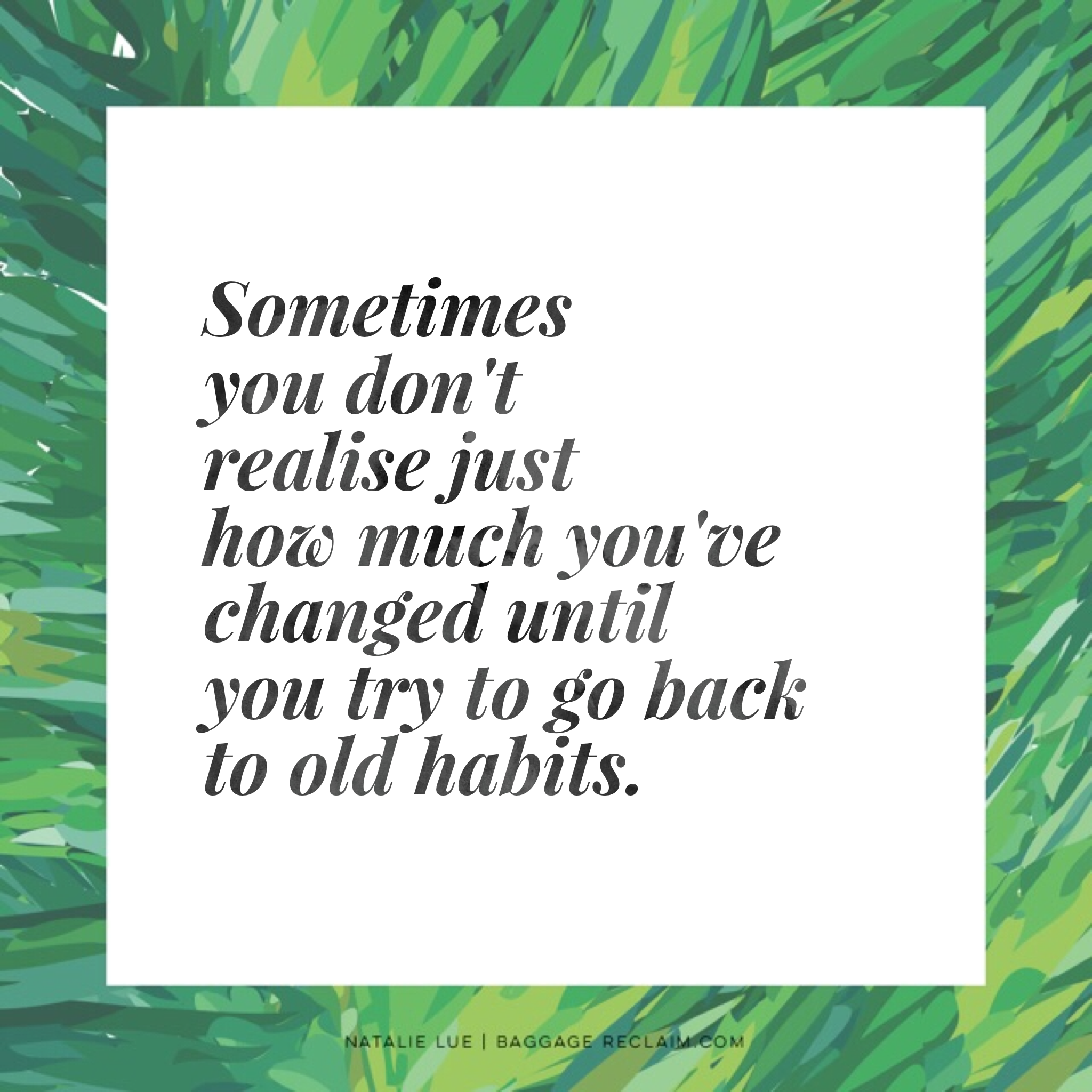
Sometimes we don’t know how much we’ve changed until we or others do something to or around us that makes us uncomfortable or even causes us pain.
And sometimes we don’t acknowledge how much we truly need to change until we realise X amount of months/years passed, and we were in effect able to press the reset button on ourselves and pick up where we left off. That realisation that we slipped into doing the same thing and expecting different results, possibly because we were looking for the fairy tale outcome where we’re made to be the exception to the rule, is a big wake-up call.
It can be the realisation that we did a Sleeping Beauty and, for instance, broke up with someone and then went to sleep until they (or someone similar) came along and woke us up. We might even have done the same with a parent where we felt deeply hurt about something, got into the habit of using the same harsh reasoning to explain it, put ourselves to sleep with it, and then woke up when someone similar to them (or someone who created similar feelings in us) came into our life.
If something has happened that has caused you to doubt your progress, acknowledge the progress you’ve made and take the gold of the experience: whatever you needed to learn.
Have some compassion for yourself. It’s too much to expect perfect change, and having a bit of patience with yourself takes you a lot further than berating you.
Nothing you’ve done is a waste.
If you now recognise that you’re still approaching something or someone with the same thinking and behaviour that got you into past undesirable situations, this is a wake-up call to open yourself up to seeing things differently. Present-day experiences are inviting you to see what you couldn’t before. It would be all too easy to give yourself a hard time for not seeing it sooner, but if you step back, you notice that there’s been a progression in the pain of your experiences that made it easier to see it.
Your beliefs about something only represent your understanding at that time.
If you’re [your present age] but you’re using reasoning from when you were, for instance, five-years-old, to explain something that happened last year, this is a block to experiencing greater contentment in and out of relationships. Doggedly clinging to a reasoning habit despite how much it hurts isn’t working for you. It would be better that you relinquish the thought process than you relinquish your desire and need for something better. Sure, it involves getting uncomfortable, but if where you’ve been comfortable has hurt you, stretching will positively transform your life.
You wouldn’t believe how timely this post came. Just did something that totally break NC. But it so right, although I am not quite where I want to be just yet (namely not breaking NC altogether and don’t give the slightest care about the ex), I realized that I have a different feeling and perspective when I interacted with the person.
Self care does help, I don’t feel the ‘normal’ urge to come running back to him the moment he decided to want to ‘start all over again’. And allowed him just to press the reset button so easily. Instead I my head somehow keeps reminding me how bad it was the last hundred times I was with him. So there is progress. Although not as far as I wanted it to be just yet.
Thank you again for this site. It helped me reflect on so many things on so many levels.
Joanna
on 23/01/2017 at 11:39 pm
Excellent article. Thank you so much Natalie!!!
This was so perfect for me!!!!
Very encouraging!
MillionReasons
on 23/01/2017 at 11:48 pm
From Natalie: “…we were in effect able to press the reset button on ourselves and pick up where we left off. That realisation that we slipped into doing the same thing and expecting different results…”
“Your beliefs about something only represent your understanding at that time.”
While reading this entry I slipped back into the now proven to be fantasy that since things did once change- his commitment to divorce- that even though they have reconciled- things can change back. Now I don’t believe that I have the power to create this change because that is the domain of the universe. Giving it up to the universe is self care for me. Not saying that I can hold on to this 24/7; not saying it is a linear experience: just saying I am experimenting with this. And that nothing I have done is a waste. I made the best decisions I could based on the information I had at the time.
Shar
on 24/01/2017 at 1:52 am
I feel I had come such a long way over the last 12 months with my 6 year on and off relationship. I did not want to be used any longer. So every time he came back I wasn’t as in to him (although failed to refuse him). I no longer pined for him when he would disappear and at New Year I decided to hand it all over to the Universe. My wish was to finally detach from this man so I would lose all feeling for him. I don’t know whether I got my wish, but after several contacts from him to catch up, which I managed to refuse, I was really proud of myself. I thought I was detaching. Then two days after the last contact where he begged me to spend the night with him, he got married to his ex (mother of his child). Is that the Universe granting me my wish to detach? I am no longer proud of myself because I am now back to pining and feel I am addicted to his lies. Not sure I’ve really made any progress at all now.
Sandra
on 26/01/2017 at 7:14 pm
Hi Shar
Think you dodged a bullet there!!! Two days after he is begging you to spend the night with him he gets married!! Haha what kind of man does that….oh that’s right an arse clown. Come on, if that doesn’t show you what kind of man you were involved with I don’t know what will.
Are you pining because you think that maybe if you had stayed the night with him it could very well you that is married to him?
The reality is, he will not change, he will be up to no good in his marriage soon. You can bet on that!!
Solstice
on 30/01/2017 at 4:06 am
Thank you, I needed to hear that! I had a similar experience. My ex of 5 years blind-sided me with a breakup and moved his new girlfriend and kids in and got engaged within 3 months. I have been heartbroken. He contacted me for dumb things a couple times but just reached out and was all sweet. Even though I knew I could never go back to him, it did make me feel special like, “hmm, maybe I DID mean something to him..” then I found out he just got married. Wth? I’m not sure if he contacted me right before the marriage or after but why would you reach out when you just got married (or were about to?) Wouldn’t that be the time you were LEAST likely to? I can see after the thrill wears off but it seems odd. And yes, i know I should be relieved I am not the poor wife because who wants to be married to a guy who is contacting his ex but man, it still hurts a lot. Makes me feel “not good enough.”
Blue 74
on 27/01/2017 at 8:39 am
Hi Shar,
Do you want to be the woman he’s married to while chasing an other woman or women? Thinking he loves you while asking them to spend the night with him? His wife isn’t in an enviable position…
Let go of the regret! There’s nothing to be sorry for- you dodged a bullet!!! Focus on breaking you’re addiction! (I know it’s easier said than done, because I’m struggling with this too….) But this guy isn’t worthy of you and you don’t deserve someone like him!
Rachel (lupie)
on 24/01/2017 at 10:18 am
Thank you Natalie! You’re observations are so timely and ring so true for me.
Similarly to when you relapsed with your ex, I also realise that I no longer respond to these situations the way I did 4-5 years ago.
Just recently, I told an ex (from over 10 years ago) who got in touch with me via Facebook after a long period of no contact, that he wasn’t welcome in my life anymore. His slick way with words and interest in my love life was unsettling. He’s a Jamaican but currently resides in NYC, and after several months of us merely talking, sending messages and him telling me that he wants to come visit me in London as we have “unfinished business” (and me rejecting all of his charms), he finally decides to reveal that he’s in NYC cohabiting with his baby mama… That’s funny considering when I first asked him why he was in the States, he said he was doing some business and staying with family. Yeah, right.
The old me would’ve felt devastated, like when I found out he cheated on me when I was 20, but the older, wiser me just said, “And this is exactly why I can’t have you in my life.” – I simply hung up the call and have been NC ever since.
It’s entirely because of him that men who are slick with words are abhorrent to me! It’s usually just a cheap ploy to distract us from the reality of the situation, but the fact remains that he’s a dog. Once a dog, always a dog! And I’d be foolish to even entertain that nonsense talk, or allow him back into my world. Hell no!
So yes, I see that I have changed and progressed, and I’m loving it!
Shar
on 24/01/2017 at 11:18 am
Well done. Good for you. I hope I can get to that point also, without having someone else in my life to get me there. I want to be able to be so appalled at the thought of getting crumbs that I just automatically tell them to piss off. I want to be turned off someone who treats me poorly. That’s my goal.
Rachel (lupie)
on 24/01/2017 at 2:11 pm
And you will get there Shar! You just have to keep putting YOU first.
I know that when I joined BR about 4-5 years ago I felt emotionally drained, my lupus was very active due to stress, I was diagnosed with depression and anxiety and I was fed up of feeling like shit because of some sad excuse for a ‘man’ who I’d welcomed into my life again – with open arms!
I got tired of seeing my friends and family settling down and starting families, whilst I endured the torture of trying to create meaningful relationships with men who clearly had other ideas. I got tired of the lies, disappointments, broken promises, disrespect, verbal/physical abuse and general drama that comes with unhealthy relationships. I knew then, and still know now, that I wasn’t put on this earth to suffer like that. I had to put my health and wellbeing first and that meant taking a long hard look at my dating habits before making the necessary changes.
Maybe you haven’t reached your true breaking point yet? Maybe a part of you is still struggling to see the wood for the trees? But the fact that you’re here means that you’re ready to tackle your relationship woes and start a new chapter of loving yourself.
If I can do it, anyone can. 🙂
Cedar
on 04/02/2017 at 8:40 pm
@Rachel – I also have had some health issues and the EU AC future faker in my life made everything worse. I’m working very hard to push him out of my mind and move forward. I must! I also get frustrated and sad when I see friends and family finding the love of their lives and here I am — struggling. What have I done wrong? I thought this guy had potential ? Nope. Wrong. But, there is always hope. We must move on and love ourselves !:)
Michele F
on 24/01/2017 at 1:09 pm
Hello ladies, 🙂
It does feel great to free yourself from thinking about a piss-taker EUM (as I’ve recently experienced). I do wonder why, despite being pretty ‘street smart’ so far as dating a new man goes, I still ended up seeing someone like him for several weeks (wasting yet more of my time and energy). I did beat myself up about it for a while (‘How could this happen again?!’) until I decided to (calmly) message him about his unacceptable behaviour. In order to stop over-analysing things I needed to tell him to ‘do one’. End of.
Now I’m less and less likely to give anyone the benefit of the doubt, the only problem with that is I might take it too far and be overly suspicious next time, seeing ‘red flags’ all over the place when they might not actually exist. I will try not to let bitter past experiences cloud my judgement but it’s a tricky one. I need to find a balance, protecting myself without being too ‘closed off’ to give things a proper chance. Bloody hard work sometimes this dating caper…….
Rachel (lupie)
on 24/01/2017 at 2:38 pm
Hey Michele 🙂
You do realise you had nothing to do with that cretin’s behaviour, right? Unless you can predict the future, or read minds, how was you to know that he’d pull a stunt like that? He purposely misled you.
I understand it’s tempting to start absorbing blame seeing as we’re the common denominator in all of our failed romances, but as Natalie once said (or something to that effect), we can’t take responsibility for other people’s actions. We don’t have that kind of power! He was a low-life and would’ve done that to any woman who crossed his path.
Please don’t let it dishearten you, there are still good men out there! If anything, let this incident be a reminder that nothing is certain in the dating game. We should temper our expectations in the early stages, and avoid getting carried away or thinking too far into the future until its mutually agreed that you’re exclusive.
By all means enjoy your dates (when they’re good), but we should also try to enjoy the process of getting to know someone without putting too much emphasis on the desired outcome. That’s where I used to go wrong! Getting way ahead of myself because a guy ticks certain boxes, then feeling crushed when he turns out to be another waste of time.
Maybe, if we approached it as though we’re auditioning for new mates, rather than potential husbands and fathers of our future offspring, then we might find ourselves enjoying the process a bit more…
Michele F
on 24/01/2017 at 5:59 pm
Hi Rachel,
I had ‘dropped out’ of dating for a long while before I got mixed up with this idiot, just really hadn’t been interested in anyone until he suggested we meet up (obviously I wish I’d said, ‘No thanks’ now). But I thought, ‘What the hell, why not’? (Nothing ventured, nothing gained and all that). I felt that I had a really healthy attitude about it all, just taking it one date at a time and not looking too far ahead. Everything felt normal, we were just getting to know each other, all good. That’s actually WHY his behaviour felt like an emotional ‘slap in the face’. If he’d been really OTT on our dates, future faked, etc. I would have been suspicious and seen trouble ahead, but it wasn’t like that so I had no warning of what was about to come. It’s kinda scary how cold and calculating some ‘men’ can be!
I’m trying to think positively here but sometimes it really feels like the decent men have all been snapped up and there’s nothing but ‘wrong’uns’ left out there. I’m gonna try not to go back into dating ‘hibernation’ again but I can’t help feeling pretty disgusted with things at the moment. I do use my common sense (and my intuition) of course, but as I don’t have a ‘crystal ball’ who knows what the next guy I take a chance on might have up his sleeve?!
misspriscilla
on 25/01/2017 at 5:32 am
I feel that, Michele F.
Over here, it feels like every guy I meet is crazy.
For real, it goes from “Hello, I’m (Tom, Steve, Billy)” to “I’m so sorry I said/did that, I’m (bipolar, depressed, have PTSD). . .in the same conversation, on the day we met! Seriously, I am not exaggerating, and I would not b/c so many people are in relationships like that. Some can handle it, I’m not the one, though, with a new person in particular.
It’s like I’m being tested to see if I’ll say or act like all, “No worries! I’m good with (your preferred mental illness) and fine with the (insult, lying, blaming, raging). There, there, now, I’ll ignore all that and take care of you so that we’ll be happy, always. Want some sex and a homemade meal, so we can both feel better about this hell?”
*sigh*
Rachel (lupie)
on 25/01/2017 at 11:57 am
I feel you too Michele! I fully relate to your reluctance to put yourself out there again, I was in the same predicament myself not that long ago.
Sadly there’s no way of telling whether a date will turn out to be EUM etc, or not. No matter how much due diligence we do, these guys are much slicker these days. The proverbial “wolf in sheep’s clothing” springs to mind when I think about my past experiences. And I’m a pretty savvy woman myself, but some of these bad guys play at being a good guy so convincingly that I was none the wiser! Had zero reason to suspect foul play, which makes it all the more disappointing when they reveal their true colours.
Dating is pretty much trial and error… Or suck it and see kinda thing. Sometimes it’s the guys who seem perfect on paper that are the worst in my experience. We just have to keep an open mind and heart, and try to trust the process. Easier said than done, I know.
Michele F
on 25/01/2017 at 8:55 pm
Hiya Rachel, 🙂
It’s just so disturbing how many of these freakish man-children ‘walk among us’ happily messing around as many women as they can (even savvy ones like ourselves). What sort of person actually enjoys trying to mug people off like that? What sad, insecure excuses for men they are. I really don’t understand people who make themselves feel good by making other people feel bad. What is up with that crap?
I’m sure I will soon ‘dust myself down’ and carry on with this dating business again, trying to resist the feeling of ‘waiting for the other shoe to drop’. If the next guy is really ‘spot on’ with everything I’ll TRY to enjoy all the attention and not read anything sinister into it. Who knows one of them might be an actual nice guy (would make a pleasant change), rather than yet another oxygen-waster.
OvertheDrama
on 24/01/2017 at 3:11 pm
Great post. I’ve been NC with my ex for about 5 months now, since he did what I consider to be the unforgivable. Proud to say that I haven’t backslided, and have been doing a lot of reading and soul searching to better myself.
My fear is also seeing red flags everywhere where there are none, or repeating the same mistakes with a new version of the same man. I’ve been consciously trying to be different and choose different. And, can at least “catch myself” mentally now – when I mistake hallmarks for landmarks or find some stupid random thing we have in common as a “sign”. I just hope to not make the next man pay for my exes short comings.
I’ve been “dating” a friend of mine for a little over three months now. Things have been great, but I had a meltdown after an awesome weekend together because I realize that we did have the exclusivity talk but not the in a relationship talk, and I don’t want to be used. It’s getting to the point where I actually like him, and feel as though if he doesn’t see this progressing to more than just a shag and a couple dinners, then I have to cut this thing off soon. Anyway, my point is that I haven’t gotten it all figured out yet, but I am making progress because you are right – my thought patterns have and are changing drastically.
misspriscilla
on 24/01/2017 at 8:01 pm
*sigh* I really don’t like commenting too closely on people’s personals but this one really reminds me of MANY MANY confusing situations that I have been in with MANY men, over time.
We as women have gotten *so afraid* of being clear that we want marriage — or *some type of* firm commitment from men. Let alone being open about the desire for children!
I kinda feel like a lot of times, the guy doesn’t have it all figured out for HIMSELF yet. . .but wants the option of a lot of sex while he does get it together. And wants us to not have anyone else around but he also has not staked a real claim on commitment.
I have a friend who told her man after 6 months — I will leave if we’re not married in 1.5 years. It worked — they are married now, and happily, far as I know. I know another woman from way back who *broke up with her boyfriend* and got with another guy rather quickly but then the “ex” stepped up to marry — that’s been YEARS.
I’m not saying those approaches work for everyone, personally I’m too chicken, and also more relaxed about marriage. Yet, I have learned over time that men need to marry more than we do, in order to have some semblance of commitment and devotion to a relationship. Marriage-minded types step up, even if they are “not ready yet”. And then. . .there are others. . .those are the ones that confuse us.
That’s why married guys are SO APPEALING–they come off as SO SURE OF THEMSELVES “about us,” — even if all they want is an affair!
I think a lot of the times men want our nether regions in the cooler for themselves with not that much backing up taking that off the general market. I think a “go with the flow” type of thing doesn’t work for us, if we want to be MARRIED and not an indefinite “girlfriend.”
So. . .whoa — danger girl. Talking about being in a relationship=talking about being in a relationship. . .which this man did not do with you, at least not yet.
Shag-sivity=the exclusivity of booty-bumping, not the love, care, trust and respect that committment requires.
I didn’t even see the word “girlfriend” mentioned at all. Me personally? One time, I texted a guy who tried to get a booty-thing going with me VIA TEXT mind you — I just asked him straight up — What does commitment mean to you? What are your relationship goals?
And never heard back — which I consider a “win” and a reminder of my changed habits b/c I made the effort to respond in an unexpected way. Out of frustration, really — that was the first time I had ever done that, before or since — about 1-2 years ago, I forget.
I mean, A LOT of guys truly squirm at the thought of one woman, one nether region, for LIFE. Women? We don’t want to sleep around indefinitely, even if that doesn’t necessarily mean a legal marriage type of deal.
You didn’t say much, other than that things are going well but then you freaked out — that could mean a lot of things. . .including that 3 months of “dating” is too soon to expect a relationship from a man. Is it possible that b/c you were friends first, it seems like more of a “relationship” than it really is? And you went from “friends” to “friends with benefits”? If your gut is telling you he’s “interested in” shagging + dinner but not a committed relationship — danger girl, you’re probably right.
Just saying — did you ask the person his relationship goals in “the talk” you had? If not, and/or if you are not clear on that yourself, perhaps that sort of laser-focused clarity could help you — it sure did me!
misspriscilla
on 24/01/2017 at 7:30 pm
Yeah — I think this post, the one about people pleasing, and the one
about interest vs. comitment go nicely together.
I’m thinking self care helps you to value yourself so that you can
break any mixtape of “I am not good enough” or “My needs are not important” or “I have to seem invisible” etc. etc. and in sets a behavior cycle that feeds whatever false belief.
From what Nat said in the last paragraph “If you’re your adult age but you’re using reasoning from when you were, for instance, 5”
on to the end — that false belief may have been CONSCIOUSLY set in
childhood but as adults it is now UNCONSCIOUS, or programmed.
That’s where the people pleasing to people who are only interested (varying degrees, mind you! and never enough to make a comitment! romantic AND non-romantic) comes in. Also, false belief tapes are catnip for EUM men, who have their OWN false belief tapes running: “I am the center of the universe” “Women exist for my own pleasure,” “I can’t get too (emotionally) close to anyone” etc. etc.
For some people, they can automatically dismiss weird stuff from other
people and carry on with life. Others of us can’t or can’t as well, and we
have to learn and practice–by self care, setting boundaries, etc.
I’m thinking breaking NC is simply an urge to resist the will to change and
to reinforce the old tape. That’s OK! You have to consider that the old mixtape has been there a long time, of course it will take some time to replace it and for it to be incorporated into A REAL part of us.
Yeah — things are gonna feel weird in our new world(s) we create for ourselves! But hopefully not as weird/bad for us as the stuff others did/do.
LauraG
on 26/01/2017 at 10:14 pm
Miss Priscilla,
Your words “I’m thinking breaking NC is simply an urge to resist the will to change and to reinforce the old tape,” really wrapped up Nat’s article for me. I have been NC from my Narc for 3 years and I can see a lot of progress. So much that I almost don’t recognize myself emotionally. I am 57 so I have done a real inner intensive that included therapy and lots and lots of reading books and journal work, dream journal, etc… I’ve dated a bit and had two brief 6 month relationships. The first was a major klingon I couldn’t get rid of and the second was a kind of open-relationship that was very interesting in that he never lied to me or said he was anything but what he was. Very healing for me, actually, but I started having feelings, told him so and got out. Then I did a really ballsy thing for me: I told him I didn’t want the “consolation prize of friendship.” Straight Natalie quotes. And that was because I knew I’d be one of his “friends” that he occasionally taps for strings free sex. HAREM ALERT.
So, just recently, a new temptation to run away from all my changes has emerged. A married man at work. Very hot. he keeps coming into my office for “hugs.” Which feel great and which I am not lying to myself about. They are crumbs and I am horney. It took what you said, Priscilla, to see that what I am really doing is scooping up a bit of yummy fantasy to avoid all the huge changes I am making in my life.
I love this blog. All you ladies are like my truth serum.
MillionReasons
on 24/01/2017 at 10:15 pm
From Shar: “Is that the Universe granting me my wish to detach? I am no longer proud of myself because I am now back to pining and feel I am addicted to his lies. Not sure I’ve really made any progress at all now.”
I look at the powers of the universe as a process rather than a result and for me it has never been linear. I engage in the process by studying Buddhism, meditating, and working the eight limbs of yoga. On the internet I’ve found tinybuddha.com helpful (it was that site which referred me here). On a less spiritual and more clinical level I am very into attachment theory as it applies to adults and relationships. Shar, imo there is more than enough in our worlds to potentially deflate us. Don’t deflate yourself.
As misspriscilla said: “I’m thinking breaking NC is simply an urge to resist the will to change and
to reinforce the old tape. That’s OK! You have to consider that the old mixtape has been there a long time, of course it will take some time to replace it and for it to be incorporated into A REAL part of us.”
Thank you, thank you, thank you.
Abdab
on 24/01/2017 at 10:31 pm
Ahhh, thank you. I berate myself because I’m still not behaving in the way that I think I would like to be – completely grown up and magnanimous while at the same time stepping out with a super hot new prospect, but you’re right. My behaviour demonstrates (positive) change. I don’t chase any more, I DO treat him with polite disinterest and I am feeling better for it.
I’m glad you pointed out that I have changed for the better, I think in expecting to be totally ‘over it’ I neglected to see the lessons that I am still learning from it.
You rock Nat!
Cinnamon
on 25/01/2017 at 6:26 pm
Abdab:
“I don’t chase any more, I DO treat him with polite disinterest and I am feeling better for it.”
That’s the spirit. It took me a while to get to this state of disinterest with the ex-covert N even after NC.
I have made progress since then (2 decades ago) however I’ve probably been over analysing this past year. I need to reclaim calm.
I’ve been over him for a long time in terms of him. Relieved he’s not a part of my life. BUT This is where I am -> stuck <-: I cannot seem to get over how he treated me. I went decades not giving him a thought or just disinterest. However since finding out where he's working it has stirred up concerns for the vulnerable (as I was) young people in his care.
I know I shouldn't berate myself that I didn't leave sooner because I didn't know he is a covert narcissist or realise the extent of his abuse.
I am not responsible for the way he behaved (despite him implying I made him that way at the time). Neither am I responsible for his behaviour now but that sometimes plays on my mind about the youngsters potentially involved.
I wish to get back to feeling Meh!
Cinnamon
on 25/01/2017 at 6:27 pm
That’s not a smiley after “stuck” BTW
Lacy
on 25/01/2017 at 2:52 am
Hey I had a long on again off again relationship with a guy who was dealing with me and 3 or more others he wind up going to jail is the only way I was really able to stick to no contact which is very sad and pathetic on my part of always let him suckered me back in with all the crumbs justhe looked so good to me I was an idiot 4 mths later after he went away I got swooped off my feet mothers day presents and dinners shopping out of the blue cash just because edible arrangements delivers to my job for one night for him to say he is on the way to my house and never show up call or text the next day around 5pm he called and said his phone had died he was drunk and at a club his friend had his car and left and he couldn’t call me because his car his friend got back too late to pick him up so he didn’t call me because he knows eway I was sleep and it was too late I told him I was done and I was for almost a mth where I went out on a date only for him to show up at my house as I was leaving and I ran back inside til he left when I got back home he called I felt bad and he begged me to stay with him and I did on my for us to have lost trust in each other and arguments everyday for silly stuff
We continued on for almost 2 yrs for him to be less and less in the relationship for him to go to dinner with his teenage daughter the mother and her entire family without twll me anything for me to see the pic on Facebook and he say it was just because it was his daughter bday the family wanted a pic and I went for it for down the line for me to be called in vday late with no plans for me to cut contact then go back a few weeks later after him begging and me going for the bs for just this pass thanksgiving him to not show up at my house but go to his baby mother house that he claims they are not together that she has a man he said he only went to see his kids because he was with his cousin from out of town that wantedto see his kids a 17yr old 15 yr old and 13 yr old and so I cut contact again for on Christmas him to show up at my house and take my kids and I out to the movies and I thought it was nice and a start for change the next day I called him and he didn’t answer he called me around 10 and seemed very uninterested I was so hurt and confused how I see it we were together for a yr and the second yr he may have found someone else or got back with his kids mother and I missed the signal to move on myself
I am a bit sad he sat he came over and I went to the door to talk to him he wanted me to come out so he can buy me shoes so I went hit shoes and we came home and he left right back out the door said he had to go help a friend move a TV this was about 8 he had called all week saying he missed me but ran out as soon as we go back home 1 thing I haven’t done since Christmas was have sex with him but I see now it’s a waste giving chance after chance our relationship had been gone
Silvercloud
on 03/02/2017 at 3:16 am
Lacy,
I dated a meth dealer when I was young (he had hid this from me, though there was every other red flag for me to see to get out).
Anyhow, had he not gone to prison, I don’t know that I would have gotten away. If not for him being sent away for years and years, I’d probably be dead or in prison myself.
This is a great post and resonates well with what I experienced this past weekend.
“My new level of consciousness did not fit into my old habits.”
This past weekend, a good friend was in town. I’ve always admired this good friend. She has a way of making everyone think she is amazing and attractive and her way of life is the best.
Then she told me she’s been cheating on her husband with a married man. Now I was cheated on by my ex husband so of course I have a very strong reaction against cheaters and their Affair Partners. And I’ve also been doing alot of reading on cheating and narcissists.
In that instance, it finally dawned on me that she is a classic Narcissist. That everything that she’s done in life bears all the trademarks of being a Narcissist. But most of all, because her values do not sit well with mine…and because I’m in the midst of healing from my own divorce trauma…which includes learning to build boundaries with people including non romantic friendships, she is upsetting my peace.
So I have made a decision to go No Contact on her. But what is great is that the old me would’ve just accepted her bullshit and excuses about having the affair. The new me says this is wrong against her husband and I’m taking a stand against it. That’s when I know I’ve made progress in my healing.
Mac
on 12/03/2017 at 9:02 am
This is absolutely brilliant progress LWBR. I would love to see my abusive ex’s friends see her for who she is too!
She was always the victim in past relationships, and the men always cheated on her. But somehow it was ok for her to meet up with her ex and go for lunch with another man ‘friend’ after I had the “where is this relationship going conversation.” Even though I got questioned what I was doing each time I was looking at my phone!
These people are very good at telling their friends things in a way that makes them sound as if they’re in the right for their actions or being wronged by others actions. She didn’t like it when I said I can’t judge her husband (separated for years, not divorced) as I’m only taking her side of the story.
I’m sure you’ll be in the wrong for not calling her, and your name will be mud to other friends in your circle as you’ve finally worked her out. Good for you.
Miho
on 25/01/2017 at 8:25 pm
Hi Natalie and Baggage Reclaim Devotees:
I’ve been in an on-again off-again relationship with a Narc for the past three years and had my longest stretch of No Contact (three months) until I caved over a week ago. I just implemented No Contact again after my Narc admitted that he was seeing one of his exes and wanted me on the sideline (the same triangulation scenario I was in last year). But this time, I feel much stronger and more resilient than previous breakups. I’m not pining for him and the initial gut-wrenching pain wore off pretty quickly. I used to feel rejected and humiliated each time my Narc crawled back to his ex or found a new victim, but at the moment, I feel free. A sense of relief and peace washed over me when I went No Contact again, and that was validation enough for me to know that I’ve made progress. So, give yourselves credit and affirmation for any steps (big or small) that you’ve made to regain your self-worth. No one can be kinder or more loving towards you than you!
Michele F
on 25/01/2017 at 9:20 pm
Miho, Well done for taking back control and standing up for your self-esteem. Guys like him need to know that we are not their ‘playthings’. Keep that NC going girl, we know you can do it! 🙂
Miho
on 26/01/2017 at 12:26 am
Thanks, Michele F! This has certainly been a long road to recovery with many setbacks along the way. But I think I’m seeing that it’s a process I have to go through to discover my inner strength and power. Appreciate the support!
Karen
on 26/01/2017 at 3:48 am
I believe that certain people are brought into our lives to teach us lessons. I always wondered why I drew cheaters, and I always felt so crushed and victimized when one more rat who professed her love ended up cheating on me.
One of them really broke my heart.
Then 10 years after we broke up, after zero contact, we reunited for a brief while. She was my One Big Love and the second time nearly killed me.
I had to burn that bridge and say things that made her hate me. At first I regretted it because I missed her, but thanks to her lengthy narcissistic silent treatment, and in the meanwhile thanks to journaling, Natalie and a shrink, one day I noticed something.
I no longer cared if I ever saw her or spoke to her again.
In fact, I’d refuse to do either again.
I’m no longer attracted to people like my philandering dad, and I’m no longer acting my martyred mother.
I started reparenting myself, and doing a better job than either parent ever did. Now I don’t let me put up with anyone’s crap at all.
My life is so much happier now, but I’m not about to give her any credit.
She, Part 2, was the catalyst for me finally healing, but she certainly didn’t mean to be.
Closure is so much better when we do it by ourselves.
Used
on 26/01/2017 at 3:43 pm
EXACTLY!!!
Cedar
on 04/02/2017 at 8:54 pm
You make great points and I feel the same – you meet people and they are in your life for a REASON! My EU AC met me and gave me a huge boost of self esteem about myself after I had been rejected by what I thought was going to be an amazing relationship. He picked me back up, dusted me off and I felt rejuvenated. Well 5 years later and we are best friends with blurred lines and not in a real relationship. My self esteem is low, and he sucks being a friend. He has hurt me deeply but yet I find I am scared not to have him in my life because it’s all I know. bUT , as noted below, he has changed so I often say, “if he was like this, we would be great together.”. No. Just stop! I think I have always been attracted to the men who need that extra caring female who will listen to them moan and complain, or feel bad when they are sick… I’m OVER it. I find I really don’t have the energy anymore to deal with him. He recently asked a favor of me out of the blue. I made calls, did research for the items he needed by a certain date. The man never thanked me, and he never showed up to get the items. Oh but I did hear from him when he randomly told me he was exhausted from working so much. Really? He lives in another world and I don’t know how to handle him anymore. I know I can’t go backwards, I’ve worked hard to build myself back up since he destroyed my heart.
Rebekah
on 29/01/2017 at 6:13 am
I thought I had really made progress when I met this guy, who seemed like a gift from God dropped into my lap. More like a lesson from God to see if I really did learn anything. A year of fighting with him for the love, care and respect I deserve and I was done. How do we know if we will ever outgrow this thinking? I’m getting too old for this nonsense.
Anna
on 30/01/2017 at 9:45 pm
Finally. The bubble burst yesterday. I am done because I saw and felt what a waste of time he is. Finally I don’t adore him anymore. Something lifted off me in a reaction to a text message from him. I feel angry now but in a healthy way, not because I am hurt. I am grateful for the revelation that he was not that special after all, and so relieved because the addiction seems to have worn off. No Contact will be no longer a struggle and from here on it will be a pleasure. He will likely chase again because he came back only recently to run away again. He comes back when he sees me pull back, but this time I am doing it because I really want to, and I wont have to force it. He is a selfish and confused person but that is ok I will just live my life and so can he. I have also realised that he chases me to get reassurance that he is “wanted” at my expense and disappointment and he has so messed me up. I picture him now and no longer see the huge attraction I had for so long. It is a most confusing and powerful condition of the mind. Getting over an addiction like this is worth fighting for. It has been a very devastating, cruel and exhausting 3 years. Thanks Nat
FireNice
on 04/02/2017 at 8:56 pm
Carbon copy of my situation.
Silvercloud
on 03/02/2017 at 3:07 am
Definitely feeling the massive failure blues. I have no friends and am pushing through extreme anxiety while job searching. My highest anxieties are related to jobs. I guess I feel grueling pressure to make it on my own as I have no family I’m consistently close to.
I have a habit of starting up social media and then deleting it. This last time I realized why. I had only a few people I felt I could authentically follow (two of which were in the public eye). And just one friend (whom I realize I put all my social needs on). Having this account made me feel like the isolated, awkward, hurting, and alone 3rd grader I was gazing out the window of the world never finding a place to participate because there was none available to me.
I was an artist very early on (started seriously drawing at age six), and where I lived offered very few outlets for serious artistic expression (there were no opportunities available to me outside my room when I was young, and I had zero substantial family encouragement). Anyhow, it feels like elementary school all over again inside.
I have found myself devoid of human contact (I have a beloved senior dog companion) and desperately needing work. (The job hunt could be going much worse mind you; I have found that people here are incredibly gracious and helpful in that arena…my severe and debilitating anxiety attacks are what’s standing most in my way). Anyhow, I had to give up caring for my grandparents as they needed much more care than I could give, and I have to have the time to find employment. The transition has been somber. I miss them as they’re the only family I have.
Anyhow, I’m just angry at myself because I mismanage my funds sometimes (overspend) and I need to be stringent about budgeting so I can afford what I need (I have a hard time telling between want and need). I spent too much on food and makeup today and I feel so guilty because I am failing at so much.
I am going to try headspace. And Natalie’s podcasts have been the best thing at battling my decades long suicidal ideation struggles. So far I’m on #21. Going to catch up. Going to get them all.
Gabriela
on 03/02/2017 at 4:30 pm
Sorry to hear that you’re going through that. I can’t offer much help, but I do understand what you are going through. I really do. I wish there was a magical formula to make everything better, or a few words I could say that would provide lasting comfort, but I know that there aren’t, really. Having been in similar shoes for pretty much all my life, I just realized we are the only ones that can make true lasting changes.
And please be nicer to yourself regarding the spending! Of course it’s hard when the resources are limited but it’s not wrong to want something that you don’t “need”… but let’s be honest, we all have our moments. If you really think it was “wrong” to buy stuff you didn’t truly need, just forgive ourself.
Silvercloud
on 04/02/2017 at 8:41 pm
Gabriela,
Thank you for taking the time to comment. I realized I have some unrealistic spending patterns, and in order to move on, I do have to forgive myself; feeling bad about and berating myself is one of my triggers to overspend, ironically.
Recently someone offered me a great mini job opportunity type thing (I’m learning to not be so extreme with myself involving work. Good work for good pay is fine).
I also asked a young woman to give me tips on affordable shopping for professional settings (I’m an artist with paint splattered studio clothes who needs more of an income), and she offered to go shopping with me! So, I got some advice and made a new friend.
I’m learning to directly ask for appropriate help outside my family without expecting anyone to come save me or fix all my problems.
We’ll see. So far so good.
Gabriela
on 03/02/2017 at 4:09 pm
Thanks Natalie for writing this post. I definitely need to remind myself that even though I am not even close to being where I wanted to be, I’ve made more progress than I think.
In my case, it took a really bad fallout with a complete EUW assclown to realize that I had issues, and that I had buried these issues very, very deep. I used to be very numb emotionally and to be honest I was pretty clueless about it. Over 3 years have passed and I still am decluttering from a very emotionally abusive childhood… but so far I keep having trouble to detach from the same kind of people (the ones that trigger me into thinking they won’t be with me because I’m not good enough), while I can detach easily if I don’t perceive myself as being the problem.
Right now I am doing it again. I am/was pursuing someone who won’t even be always nice to me, and who certainly doesn’t appreciate my demonstrations of care towards her (neither in a platonic/friendly nor romantic way). I was noticing how the only feelings I have towards her now are frustration, resentment, and anger, but somehow I still get attached to this situation because it makes me feel exactly as I felt when I was a child: invisible, uncared, unloved, a POS, and worthless. Almost as if I want to change the outcome, like I want to be recognized as important, and win at least once.
I mean, I probably would feel a POS anyway because no one is ever romantically interested in me, so whenever I like someone I am kinda used for it not to work (yay, being gay sucks and you straight guys should be very grateful you don’t have to go through this). But it’s easier to understand when someone is either straight, partnered up, doesn’t have the same goals, or is simply not attracted to you. Just makes me wonder what’s so wrong with me that no one will come to me, though, while I do go after the people I am attracted to.
However I do have a question… how to deal with the fact that whatever progress you made didn’t bring the results you want… but instead brought a sense that there’s a humongous amount of work still to be done (that could take more years) and that it might never be worth it (that I might never experience a relationship anyway)?
Cedar
on 04/02/2017 at 7:57 pm
I sat back and went, “hmmm wow!” After reading this. Natalie is dead on again with her comments. I have been struggling for a year to push a best male friend away because all he does is cause me mental pain. He was never like that, but HE changed. He went from being very attentive, caring, social, funny, and laid back to bitter, secretive, selfish, and distant. All of this happened after he had some major surgery and could not work for about a year. He pushed me away and it hurt deeply. I mentioned it, and he claimed he wasn’t talking to anyone and that he lives his life moment to moment. I admit, I’m a Florence nightingale type and he and I have been extremely close since we met about 5 years ago. In my mind I figured he would leave his Girlfriend (whom he doesn’t trust and is always complaining about) for me, but that won’t happen . I learned that here. I’m mentally working on trying to move past what things used to be like with him. It will never be the same, and he will never be the same. Each time he texts me (which is also a rarity now), I jump at the phone. Sadly I remember how that phone used to be on fire with him calling and texting constantly. It frustrates me.. why the change ?? Why can’t we go back to what we had? He future fakes with me and flirts constantly but I have yet to see him in person for more than 20 minutes in 5 months. These men can torment us… on days when I haven’t heard from him I feel better and feel I have made progress. Things go downhill when I hear from him and he doesn’t keep a promise, or he doesn’t have time to come over. If only he could see what he is missing — the laughter and fun times. Sigh. This is all baby steps..
Shar
on 05/02/2017 at 3:04 am
Hi ladies
I was so angry at the AC after he secretly got married and had to contact him to vent a few days after the wedding. I wanted revenge so badly that I threatened him with everything to get my $7000 that he still owes me (and is paying me off so minimally into my account that it will take another two years), I abused him and called him for everything, until I had nothing else to say and was left with the only feelings that were true, just utter sadness at being abandoned and rejected, jealousy and pain. I realised I just had to sit in those feelings of despair because no amount of abuse or threats were going to change what had happened and I just had to feel it all. The only thing the anger was doing was helping me escape the heartache I really felt. I have also made sure I am off all social media that risks me seeing anything about him or his family. I need to protect myself from reminders of him, what’s happened and I do not want to know anything about him. I’m not sure if that’s hiding or protecting, but it feels better.
I so hope that I will feel better in 90 days – not so raw. In that 90 days I just want to look after myself. Mix with people only if I feel like it or hibernate if I don’t. My goal is to love myself and to be honest I’m not sure exactly HOW to do that. The only thing I can think of at the moment is just to feel the emotions as they come up, try not to think about him, be gentle with myself for being hurt and on a practical level, go hard at the gym, eat clean, dunno what else. I so hope that as I learn to love myself, an assclown like him will be far less attractive to me.
FireNice
on 05/02/2017 at 5:08 pm
I also ditched social media – over a year ago I left Facebook and Twitter because I couldn’t stand to see people talking about him, and how funny and amazing he was while I saw the selfish side. It hurt way toooo much. He will randomly tell me how popular he is on twitter — I believe he is addicted because he doesn’t have to talk to anyone or answer to anyone in real life. I was pushed aside so he could have a relationship with Twitter and his thousands of followers! So I don’t consider it hiding from him, I consider it a way to push forward and heal. NC is so tough but it has to be done. I question why a guy would treat me like this after so many years of fun times and memories — feels like he took our good times and just dumped it on the curb and drove off.
InkedMusic
on 05/02/2017 at 5:25 pm
Music tends to remind me of the AC and can either motivate, or bring back a sea of memories. Any of you ladies heard these?
The Veronica’s- You ruin me (deep song and sooo emotionally true)
Rihanna- Stay (the lyrics are spot on for when I met him…)
Barns Courtney- Fire (now I exercise and focus on other things while jamming to this and other songs that get me pumped up!)
PatMG
on 07/02/2017 at 12:31 pm
Ladies hello!:) how do you deal with a guy that likes to future fake, pop in and out of your life in his terms, and projects that he is the best thing since sliced bread to the world — but he’s not ? Mine can be very selfish and secretive, and will disappear for a week at a time. He will then suddenly text me about something that we both enjoy, or share photos of something that made him think of me. I know he has feelings for me (we are best friends and he just admitted feelings for me), but I never get to see him in person. He’s always traveling for work. When he is home, he is busy in his office . Bottom line , i wait .. and I wait… but he just doesn’t reciprocate. Should I back off and not text him and see if he will finally come to me a d show me more attention???? Gahhh please advise!
Michele F
on 07/02/2017 at 3:10 pm
Hi PatMG,
You know the answer yourself, but I can confirm that you should definitely stop expending any more of your valuable time on him. After all, he’s made it quite clear through his (at best) sporadic attention to you that he thinks it’s all about HIM. The little scraps he throws at you occasionally are not enough for you to live on. He’s doing this just to prove to himself that he can keep you hanging on, he’s not offering the real, RESPECTFUL relationship you deserve. Please don’t excuse his behaviour (there is no excuse) or think that you can somehow change him (you can’t). Any guy who shows himself capable of this sort of crap should be avoided at all costs. Seriously.
Anyone who plays any of these games (future faking, blowing hot and cold, disappearing for long periods, etc.) should be dropped out of your life permanently. I dealt with an idiot like this recently and (after several weeks of dating him) realised that I would never get anything but disappointment and heartache from him. It felt GREAT to free myself from his manipulative emotional grip (trust me), I immediately stopped thinking about him and stopped trying to figure out why he’d acted the way he did. Those are HIS issues to deal with, not mine. Good riddance to him.
I know you can do the same. You need to fight for your self-esteem and take your life back from this uncaring, narcissistic man before he saps any more of your energy. Good luck. Be kind to yourself! 🙂
PatMG
on 07/02/2017 at 8:51 pm
MicheleF- thank you sooooo much for validating my own thoughts. I have been dealing with this for a few YEaRS now. Yes sadly years. I look back at the friendship and how much I gave, and how much he gave and the % is wayyyyy off! I honestly do not know if I even trust him at this point just because of the way he acts. If he said he cares for me, and because of his busy life blah blah I should understand the way he acts blah blah.. well do I? My problem is that I want to change him into something he is not. When I start to move forward , I do NC and I put his number on do not disturb. I remind myself of everything you said MicheleF — things I know deep down but I fight to really accept it. I also ask, what am I going to get from him? Probably nothing. He says he wants to travel with me, come over and do a movie night, help me fix some things in my house… it won’t happen anytime soon. He just lives in his own selfish world. I needed him to bring me some documents that were required for a job I have (with his job, he has access to them). He told me he would happily help me. Do u know how long it took? 6 fricking months. He didn’t have time for me to help me because he was so busy with his job . I finally told him I would just find someone else to help me and he got very guarded and promised he would stop into my office with what I needed. Sure enough he did stop in as he said. He was worried I was going to shove him aside …. I think that he needs to be put in his place and make him realize that he is going to lose me. It’s been wayyyyy too long dealing with this and him asking advantage of my friendship. I don’t want to make excuses for his behavior anymore, i just want to move on and it’s NOT EASY. It’s not easy finally realizing that he is just keeping me in his back pocket for when he needs me and wants me for something. It’s not easy knowing I valued what we had and thought it was real, and now I don’t know a clue as to what is real and what isn’t. I don’t know if I trust anything from him… gotta move on. ????
Michele F
on 08/02/2017 at 1:33 pm
Hi PatMG,
‘I DESERVE BETTER’ should be your new mantra, keep repeating it in your head again and again.
You are feeling all these negative emotions because of his selfish behaviour. This cannot continue, it’s no good for your spiritual (or physical) health. Believe me, I’ve been there (driving myself mad trying to understand why a guy has behaved so badly towards me). The answer is simple: That’s who he is (and always will be). His actions speak louder than words. NOTHING you’ve done has caused that and nothing you do will change that. End of.
Stop thinking about what might or should have been with him. Please FREE YOURSELF now. You’ve only got one life, don’t waste another second of it on this poor excuse for a man. Stay strong. 🙂
PatMG
on 08/02/2017 at 7:49 pm
You are absolutely right… I’ve given him so many chances , and I’ve been so sweet and kind to him. What a total jerk to treat me like this and just expect me to be there for him whenever he wanted something…i know when I go NC he will suddenly show up guilting me and wondering where I am. I also have to avoid him because we work two building away from eachother, and the possibility of seeing him while doing errands is very likely.
Michele F how did you put distance between yourself and him? Did you tell him off and tell him what a selfish jerk he was or did you simply walk away?
Ruby
on 10/02/2017 at 11:06 am
Should I go No Contact? This situation is making me feel resentful and damaging my self-esteem.
I’m married with children and I’ve been friends with this guy, who I’ll call A, for 9 years now. It started flirtily and after a year or so of chatting (my husband had shut me out due to work issues) something physical happened. I told my husband and we nearly split but managed to work things out (so it seemed). Things stopped with A for a while but slowly and gradually went back. I was always honest with my husband about things and he we never very fussed about what we discussed. Things became physical again and few years back and my husband laid down some boundaries (but not where a husband should lay them down really) and so I now live in this messed up place of being married (we have a great sex life – not intimate but good sex) and chatting daily with A, sometimes sexual, mostly just about anything and everything (plus rare hook-ups). He grew up an only child of an alcoholic father, and whilst he is the most positive, go-getting person I know, he admits it’s nice he can talk to me about this if he ever needs to (rarely) as he’s very closed off to people.
A had a girlfriend who he was unsure of. I convinced him to give her a chance. Six months later they bought a house and he proposed (he came to see me first to discuss the proposal. He said my blessing would mean a lot to him and that he didn’t want to hurt me so wouldn’t do it if it would). He stopped the sexual side at this point but we still chatted daily. Eventually things slid back to our old ways. I told him he wasn’t being fair to me, giving me mixed signals and he apologised and admitted he missed “all that” and asked if we could carry on as it’s “part of us and what we do”. He says he’s never have a bond with anyone like he does me. We have discussed the fact that we have a mental connection, physical attraction, amazing chemistry and that we’ve never known anyone who “gets” each other like we do.
However, since the proposal, I’ve begun questioning what the hell I’m doing. I’m pretty sure I’m in love with him and he must know this. We argue a lot now as I keep asking what this is. He says “It’s not fwb, but it’s not an affair”. When I compared it to his friend who had an affair and ended up marrying his affair partner, he says the difference is that “they were in love and saw a future together”. My self esteem is at rock bottom, questioning what is wrong with me. If two people have intimacy, chemistry, attraction, a connection, what else is there? And does my husband love me so much that he turns a blind eye, or does he not love me at all? A has admitted that his fiancée and he aren’t that sexually compatible but it doesn’t matter to him as there are more important things in life. This, coming from a guy who used to live for it. Maybe he has just grown up. But what am I? I’ve tried cutting him out for a year now but he will not let me go. He says we can quit the sexual stuff, the most important thing is that I’m in his life forever. He says he can count on one hand the people who he feels like that about, and I’m one of them. He is adamant that I come to his wedding next year. He says he cares about me and we’re both a massive part of each other’s life’s so why wouldn’t I go. He has been very patient and kind. I cannot say how many times I have hung up on him, etc, etc and he has called me over and over. I’ve said such nasty things and he has forgiven me. He has invited me to stay in his new house and let me meet his new friends so I know he has changed in that aspect (I always used to be quite hidden). But I cannot see the spark between him and his fiancée. She is more motherly than anything. I’m so confused. He can’t love me as he has said before he is not in love with me. He has “a love for me, more than friendship”. He seems so genuine, but I guess they all do? He spends a lot of time talking with me daily (he says he talks to me more than anyone else and that I’m the only person who get 100% honesty). It’s not like I’m a booty call. In fact, I’m the one who suggests it lately. What is this?
I’m sure there will be plenty of people passing harsh judgement reading this. I probably would have too before. But my husband and I co-parent well and never argue. I always wanted my kids to have a better home life than I did so that’s why I stay when I get no emotional fulfilment.
Lara
on 10/02/2017 at 7:08 pm
Ruby, you’re not getting emotional fulfilment from A either, and you’re not getting home life, or someone who will co-parent. You’re not getting love, care, trust or respect. It’s hard to think of what he has to offer you other than a distraction. If you want to understand where A is coming from, read Nat’s posts on ‘Interest Is Not the Same As Commitment’ and ‘Why Do They Keep Having Sex With Me If They’re Not Interested Or Don’t Want The Relationship I Want?’.
It’s really hard and I empathise as I’ve struggled with something similar. No compromise, hard core, no exceptions, total NC with concurrent self care is the only solution. It’s a path easily fallen from, but take it and keep at it till you live in light.
Ruby
on 11/02/2017 at 2:33 pm
Thanks for your reply Lara. So what about my husband? He doesn’t talk to me. He is emotionally unavailable. I am so lonely. I think that may be why I fell for A in the first place. He is interested in my day and how I am. It breaks my heart to think of him not being in my life.
Lara
on 11/02/2017 at 9:01 pm
Yes, I’m sure that is why you fell for A. Either way, run a mile from him. He’s not in love with you and he’s proved himself both EU and non-committed. At least your husband is a good co-parent, is committed to the family and provides? A is just playing with you. It wouldn’t surprise me if the had his girlfriend, you and others on the go. Imagine you had a frank conversation with his girlfriend and listen hard to what you are saying. Would you want that in a partner?
In an ideal world, the best man to be with is the father of your children and the one you’ve pooled your resources with and built a life with. Does being with your husband allow you to chase all your other dreams? Be careful not to throw the baby out with the bath water so to speak. I’m not saying stay with him regardless, just that if you could somehow rub along and be happy, then it’s the easiest way to go.
Whether your husband stays or goes, the answer to loneliness is to find things independent of a man that fulfil you. A good man is a bonus not a necessity.
In order for you not to feel so lonely, is it possible for you to improve your employment situation so that you do something you love and is rewarding? Can you make more/better friends and spend more time with them? Can you take up part time study of something you’re passionately interested in? Can you join a political group (it’s a hot area, whatever side of the argument you’re on!)? Most of all, involve yourself with your children and their interests and friendships and their future.
If you fill your life with people and situations that healthily sustain you, you will have less need for either man because you will be full already.
Ruby
on 12/02/2017 at 10:48 am
Wow. You are so right. I should have been concentrating on my husband this whole time instead of investing my time and energy into someone who, ultimately, I knew I’d never want to be with. If he cheats on his new fiancée, then he’ll cheat on anyone. I just wanted him to want me, to validate me I guess, because of childhood issues and my husband bring so aloof I guess. Thank you for taking the time to help a stranger. I’m grateful for your insight. I have a lot of thinking to do.
Ruby
on 12/02/2017 at 10:49 am
And my children. My children. Who have been pushed aside too often for me to pursue other issues relating to A. I’ll never get that time back with them. ????
Lara
on 12/02/2017 at 11:51 pm
Oh Ruby, I so understand! It’s like you want desperately to win but you don’t want the prize. Be grateful you didn’t win because all that was on offer was a booby-prize. You can still win, you just have to pick a different competition, the one where the prize is a good life. Don’t beat yourself up too much, it’s not the first time this has happened to someone. The fact that you’re on this site means you’ve already started a new journey. You have loads of time ahead with your children. Wishing you all the best!
I’ve been running Baggage Reclaim since September 2005, and I’ve spent many thousands of hours writing this labour of love. The site has been ad-free the entire time, and it costs hundreds of pounds a month to run it on my own. If what I share here has helped you and you’re in a position to do so, I would love if you could make a donation. Your support is so very much appreciated! Thank you.
Copyright Natalie Lue 2005-2026, All rights reserved. Written and express permission along with credit is needed to reproduce and distribute excerpts or entire pieces of my work.
Manage Cookie Consent
To provide the best experiences, we use technologies like cookies to store and/or access device information. Consenting to these technologies will allow us to process data such as browsing behaviour or unique IDs on this site. Not consenting or withdrawing consent, may adversely affect certain features and functions.
Functional
Always active
The technical storage or access is strictly necessary for the legitimate purpose of enabling the use of a specific service explicitly requested by the subscriber or user, or for the sole purpose of carrying out the transmission of a communication over an electronic communications network.
Preferences
The technical storage or access is necessary for the legitimate purpose of storing preferences that are not requested by the subscriber or user.
Statistics
The technical storage or access that is used exclusively for statistical purposes.The technical storage or access that is used exclusively for anonymous statistical purposes. Without a subpoena, voluntary compliance on the part of your Internet Service Provider, or additional records from a third party, information stored or retrieved for this purpose alone cannot usually be used to identify you.
Marketing
The technical storage or access is required to create user profiles to send advertising, or to track the user on a website or across several websites for similar marketing purposes.




Thank you Natalie.
You wouldn’t believe how timely this post came. Just did something that totally break NC. But it so right, although I am not quite where I want to be just yet (namely not breaking NC altogether and don’t give the slightest care about the ex), I realized that I have a different feeling and perspective when I interacted with the person.
Self care does help, I don’t feel the ‘normal’ urge to come running back to him the moment he decided to want to ‘start all over again’. And allowed him just to press the reset button so easily. Instead I my head somehow keeps reminding me how bad it was the last hundred times I was with him. So there is progress. Although not as far as I wanted it to be just yet.
Thank you again for this site. It helped me reflect on so many things on so many levels.
Excellent article. Thank you so much Natalie!!!
This was so perfect for me!!!!
Very encouraging!
From Natalie: “…we were in effect able to press the reset button on ourselves and pick up where we left off. That realisation that we slipped into doing the same thing and expecting different results…”
“Your beliefs about something only represent your understanding at that time.”
While reading this entry I slipped back into the now proven to be fantasy that since things did once change- his commitment to divorce- that even though they have reconciled- things can change back. Now I don’t believe that I have the power to create this change because that is the domain of the universe. Giving it up to the universe is self care for me. Not saying that I can hold on to this 24/7; not saying it is a linear experience: just saying I am experimenting with this. And that nothing I have done is a waste. I made the best decisions I could based on the information I had at the time.
I feel I had come such a long way over the last 12 months with my 6 year on and off relationship. I did not want to be used any longer. So every time he came back I wasn’t as in to him (although failed to refuse him). I no longer pined for him when he would disappear and at New Year I decided to hand it all over to the Universe. My wish was to finally detach from this man so I would lose all feeling for him. I don’t know whether I got my wish, but after several contacts from him to catch up, which I managed to refuse, I was really proud of myself. I thought I was detaching. Then two days after the last contact where he begged me to spend the night with him, he got married to his ex (mother of his child). Is that the Universe granting me my wish to detach? I am no longer proud of myself because I am now back to pining and feel I am addicted to his lies. Not sure I’ve really made any progress at all now.
Hi Shar
Think you dodged a bullet there!!! Two days after he is begging you to spend the night with him he gets married!! Haha what kind of man does that….oh that’s right an arse clown. Come on, if that doesn’t show you what kind of man you were involved with I don’t know what will.
Are you pining because you think that maybe if you had stayed the night with him it could very well you that is married to him?
The reality is, he will not change, he will be up to no good in his marriage soon. You can bet on that!!
Thank you, I needed to hear that! I had a similar experience. My ex of 5 years blind-sided me with a breakup and moved his new girlfriend and kids in and got engaged within 3 months. I have been heartbroken. He contacted me for dumb things a couple times but just reached out and was all sweet. Even though I knew I could never go back to him, it did make me feel special like, “hmm, maybe I DID mean something to him..” then I found out he just got married. Wth? I’m not sure if he contacted me right before the marriage or after but why would you reach out when you just got married (or were about to?) Wouldn’t that be the time you were LEAST likely to? I can see after the thrill wears off but it seems odd. And yes, i know I should be relieved I am not the poor wife because who wants to be married to a guy who is contacting his ex but man, it still hurts a lot. Makes me feel “not good enough.”
Hi Shar,
Do you want to be the woman he’s married to while chasing an other woman or women? Thinking he loves you while asking them to spend the night with him? His wife isn’t in an enviable position…
Let go of the regret! There’s nothing to be sorry for- you dodged a bullet!!! Focus on breaking you’re addiction! (I know it’s easier said than done, because I’m struggling with this too….) But this guy isn’t worthy of you and you don’t deserve someone like him!
Thank you Natalie! You’re observations are so timely and ring so true for me.
Similarly to when you relapsed with your ex, I also realise that I no longer respond to these situations the way I did 4-5 years ago.
Just recently, I told an ex (from over 10 years ago) who got in touch with me via Facebook after a long period of no contact, that he wasn’t welcome in my life anymore. His slick way with words and interest in my love life was unsettling. He’s a Jamaican but currently resides in NYC, and after several months of us merely talking, sending messages and him telling me that he wants to come visit me in London as we have “unfinished business” (and me rejecting all of his charms), he finally decides to reveal that he’s in NYC cohabiting with his baby mama… That’s funny considering when I first asked him why he was in the States, he said he was doing some business and staying with family. Yeah, right.
The old me would’ve felt devastated, like when I found out he cheated on me when I was 20, but the older, wiser me just said, “And this is exactly why I can’t have you in my life.” – I simply hung up the call and have been NC ever since.
It’s entirely because of him that men who are slick with words are abhorrent to me! It’s usually just a cheap ploy to distract us from the reality of the situation, but the fact remains that he’s a dog. Once a dog, always a dog! And I’d be foolish to even entertain that nonsense talk, or allow him back into my world. Hell no!
So yes, I see that I have changed and progressed, and I’m loving it!
Well done. Good for you. I hope I can get to that point also, without having someone else in my life to get me there. I want to be able to be so appalled at the thought of getting crumbs that I just automatically tell them to piss off. I want to be turned off someone who treats me poorly. That’s my goal.
And you will get there Shar! You just have to keep putting YOU first.
I know that when I joined BR about 4-5 years ago I felt emotionally drained, my lupus was very active due to stress, I was diagnosed with depression and anxiety and I was fed up of feeling like shit because of some sad excuse for a ‘man’ who I’d welcomed into my life again – with open arms!
I got tired of seeing my friends and family settling down and starting families, whilst I endured the torture of trying to create meaningful relationships with men who clearly had other ideas. I got tired of the lies, disappointments, broken promises, disrespect, verbal/physical abuse and general drama that comes with unhealthy relationships. I knew then, and still know now, that I wasn’t put on this earth to suffer like that. I had to put my health and wellbeing first and that meant taking a long hard look at my dating habits before making the necessary changes.
Maybe you haven’t reached your true breaking point yet? Maybe a part of you is still struggling to see the wood for the trees? But the fact that you’re here means that you’re ready to tackle your relationship woes and start a new chapter of loving yourself.
If I can do it, anyone can. 🙂
@Rachel – I also have had some health issues and the EU AC future faker in my life made everything worse. I’m working very hard to push him out of my mind and move forward. I must! I also get frustrated and sad when I see friends and family finding the love of their lives and here I am — struggling. What have I done wrong? I thought this guy had potential ? Nope. Wrong. But, there is always hope. We must move on and love ourselves !:)
Hello ladies, 🙂
It does feel great to free yourself from thinking about a piss-taker EUM (as I’ve recently experienced). I do wonder why, despite being pretty ‘street smart’ so far as dating a new man goes, I still ended up seeing someone like him for several weeks (wasting yet more of my time and energy). I did beat myself up about it for a while (‘How could this happen again?!’) until I decided to (calmly) message him about his unacceptable behaviour. In order to stop over-analysing things I needed to tell him to ‘do one’. End of.
Now I’m less and less likely to give anyone the benefit of the doubt, the only problem with that is I might take it too far and be overly suspicious next time, seeing ‘red flags’ all over the place when they might not actually exist. I will try not to let bitter past experiences cloud my judgement but it’s a tricky one. I need to find a balance, protecting myself without being too ‘closed off’ to give things a proper chance. Bloody hard work sometimes this dating caper…….
Hey Michele 🙂
You do realise you had nothing to do with that cretin’s behaviour, right? Unless you can predict the future, or read minds, how was you to know that he’d pull a stunt like that? He purposely misled you.
I understand it’s tempting to start absorbing blame seeing as we’re the common denominator in all of our failed romances, but as Natalie once said (or something to that effect), we can’t take responsibility for other people’s actions. We don’t have that kind of power! He was a low-life and would’ve done that to any woman who crossed his path.
Please don’t let it dishearten you, there are still good men out there! If anything, let this incident be a reminder that nothing is certain in the dating game. We should temper our expectations in the early stages, and avoid getting carried away or thinking too far into the future until its mutually agreed that you’re exclusive.
By all means enjoy your dates (when they’re good), but we should also try to enjoy the process of getting to know someone without putting too much emphasis on the desired outcome. That’s where I used to go wrong! Getting way ahead of myself because a guy ticks certain boxes, then feeling crushed when he turns out to be another waste of time.
Maybe, if we approached it as though we’re auditioning for new mates, rather than potential husbands and fathers of our future offspring, then we might find ourselves enjoying the process a bit more…
Hi Rachel,
I had ‘dropped out’ of dating for a long while before I got mixed up with this idiot, just really hadn’t been interested in anyone until he suggested we meet up (obviously I wish I’d said, ‘No thanks’ now). But I thought, ‘What the hell, why not’? (Nothing ventured, nothing gained and all that). I felt that I had a really healthy attitude about it all, just taking it one date at a time and not looking too far ahead. Everything felt normal, we were just getting to know each other, all good. That’s actually WHY his behaviour felt like an emotional ‘slap in the face’. If he’d been really OTT on our dates, future faked, etc. I would have been suspicious and seen trouble ahead, but it wasn’t like that so I had no warning of what was about to come. It’s kinda scary how cold and calculating some ‘men’ can be!
I’m trying to think positively here but sometimes it really feels like the decent men have all been snapped up and there’s nothing but ‘wrong’uns’ left out there. I’m gonna try not to go back into dating ‘hibernation’ again but I can’t help feeling pretty disgusted with things at the moment. I do use my common sense (and my intuition) of course, but as I don’t have a ‘crystal ball’ who knows what the next guy I take a chance on might have up his sleeve?!
I feel that, Michele F.
Over here, it feels like every guy I meet is crazy.
For real, it goes from “Hello, I’m (Tom, Steve, Billy)” to “I’m so sorry I said/did that, I’m (bipolar, depressed, have PTSD). . .in the same conversation, on the day we met! Seriously, I am not exaggerating, and I would not b/c so many people are in relationships like that. Some can handle it, I’m not the one, though, with a new person in particular.
It’s like I’m being tested to see if I’ll say or act like all, “No worries! I’m good with (your preferred mental illness) and fine with the (insult, lying, blaming, raging). There, there, now, I’ll ignore all that and take care of you so that we’ll be happy, always. Want some sex and a homemade meal, so we can both feel better about this hell?”
*sigh*
I feel you too Michele! I fully relate to your reluctance to put yourself out there again, I was in the same predicament myself not that long ago.
Sadly there’s no way of telling whether a date will turn out to be EUM etc, or not. No matter how much due diligence we do, these guys are much slicker these days. The proverbial “wolf in sheep’s clothing” springs to mind when I think about my past experiences. And I’m a pretty savvy woman myself, but some of these bad guys play at being a good guy so convincingly that I was none the wiser! Had zero reason to suspect foul play, which makes it all the more disappointing when they reveal their true colours.
Dating is pretty much trial and error… Or suck it and see kinda thing. Sometimes it’s the guys who seem perfect on paper that are the worst in my experience. We just have to keep an open mind and heart, and try to trust the process. Easier said than done, I know.
Hiya Rachel, 🙂
It’s just so disturbing how many of these freakish man-children ‘walk among us’ happily messing around as many women as they can (even savvy ones like ourselves). What sort of person actually enjoys trying to mug people off like that? What sad, insecure excuses for men they are. I really don’t understand people who make themselves feel good by making other people feel bad. What is up with that crap?
I’m sure I will soon ‘dust myself down’ and carry on with this dating business again, trying to resist the feeling of ‘waiting for the other shoe to drop’. If the next guy is really ‘spot on’ with everything I’ll TRY to enjoy all the attention and not read anything sinister into it. Who knows one of them might be an actual nice guy (would make a pleasant change), rather than yet another oxygen-waster.
Great post. I’ve been NC with my ex for about 5 months now, since he did what I consider to be the unforgivable. Proud to say that I haven’t backslided, and have been doing a lot of reading and soul searching to better myself.
My fear is also seeing red flags everywhere where there are none, or repeating the same mistakes with a new version of the same man. I’ve been consciously trying to be different and choose different. And, can at least “catch myself” mentally now – when I mistake hallmarks for landmarks or find some stupid random thing we have in common as a “sign”. I just hope to not make the next man pay for my exes short comings.
I’ve been “dating” a friend of mine for a little over three months now. Things have been great, but I had a meltdown after an awesome weekend together because I realize that we did have the exclusivity talk but not the in a relationship talk, and I don’t want to be used. It’s getting to the point where I actually like him, and feel as though if he doesn’t see this progressing to more than just a shag and a couple dinners, then I have to cut this thing off soon. Anyway, my point is that I haven’t gotten it all figured out yet, but I am making progress because you are right – my thought patterns have and are changing drastically.
*sigh* I really don’t like commenting too closely on people’s personals but this one really reminds me of MANY MANY confusing situations that I have been in with MANY men, over time.
We as women have gotten *so afraid* of being clear that we want marriage — or *some type of* firm commitment from men. Let alone being open about the desire for children!
I kinda feel like a lot of times, the guy doesn’t have it all figured out for HIMSELF yet. . .but wants the option of a lot of sex while he does get it together. And wants us to not have anyone else around but he also has not staked a real claim on commitment.
I have a friend who told her man after 6 months — I will leave if we’re not married in 1.5 years. It worked — they are married now, and happily, far as I know. I know another woman from way back who *broke up with her boyfriend* and got with another guy rather quickly but then the “ex” stepped up to marry — that’s been YEARS.
I’m not saying those approaches work for everyone, personally I’m too chicken, and also more relaxed about marriage. Yet, I have learned over time that men need to marry more than we do, in order to have some semblance of commitment and devotion to a relationship. Marriage-minded types step up, even if they are “not ready yet”. And then. . .there are others. . .those are the ones that confuse us.
That’s why married guys are SO APPEALING–they come off as SO SURE OF THEMSELVES “about us,” — even if all they want is an affair!
I think a lot of the times men want our nether regions in the cooler for themselves with not that much backing up taking that off the general market. I think a “go with the flow” type of thing doesn’t work for us, if we want to be MARRIED and not an indefinite “girlfriend.”
So. . .whoa — danger girl. Talking about being in a relationship=talking about being in a relationship. . .which this man did not do with you, at least not yet.
Shag-sivity=the exclusivity of booty-bumping, not the love, care, trust and respect that committment requires.
I didn’t even see the word “girlfriend” mentioned at all. Me personally? One time, I texted a guy who tried to get a booty-thing going with me VIA TEXT mind you — I just asked him straight up — What does commitment mean to you? What are your relationship goals?
And never heard back — which I consider a “win” and a reminder of my changed habits b/c I made the effort to respond in an unexpected way. Out of frustration, really — that was the first time I had ever done that, before or since — about 1-2 years ago, I forget.
I mean, A LOT of guys truly squirm at the thought of one woman, one nether region, for LIFE. Women? We don’t want to sleep around indefinitely, even if that doesn’t necessarily mean a legal marriage type of deal.
You didn’t say much, other than that things are going well but then you freaked out — that could mean a lot of things. . .including that 3 months of “dating” is too soon to expect a relationship from a man. Is it possible that b/c you were friends first, it seems like more of a “relationship” than it really is? And you went from “friends” to “friends with benefits”? If your gut is telling you he’s “interested in” shagging + dinner but not a committed relationship — danger girl, you’re probably right.
Just saying — did you ask the person his relationship goals in “the talk” you had? If not, and/or if you are not clear on that yourself, perhaps that sort of laser-focused clarity could help you — it sure did me!
Yeah — I think this post, the one about people pleasing, and the one
about interest vs. comitment go nicely together.
I’m thinking self care helps you to value yourself so that you can
break any mixtape of “I am not good enough” or “My needs are not important” or “I have to seem invisible” etc. etc. and in sets a behavior cycle that feeds whatever false belief.
From what Nat said in the last paragraph “If you’re your adult age but you’re using reasoning from when you were, for instance, 5”
on to the end — that false belief may have been CONSCIOUSLY set in
childhood but as adults it is now UNCONSCIOUS, or programmed.
That’s where the people pleasing to people who are only interested (varying degrees, mind you! and never enough to make a comitment! romantic AND non-romantic) comes in. Also, false belief tapes are catnip for EUM men, who have their OWN false belief tapes running: “I am the center of the universe” “Women exist for my own pleasure,” “I can’t get too (emotionally) close to anyone” etc. etc.
For some people, they can automatically dismiss weird stuff from other
people and carry on with life. Others of us can’t or can’t as well, and we
have to learn and practice–by self care, setting boundaries, etc.
I’m thinking breaking NC is simply an urge to resist the will to change and
to reinforce the old tape. That’s OK! You have to consider that the old mixtape has been there a long time, of course it will take some time to replace it and for it to be incorporated into A REAL part of us.
Yeah — things are gonna feel weird in our new world(s) we create for ourselves! But hopefully not as weird/bad for us as the stuff others did/do.
Miss Priscilla,
Your words “I’m thinking breaking NC is simply an urge to resist the will to change and to reinforce the old tape,” really wrapped up Nat’s article for me. I have been NC from my Narc for 3 years and I can see a lot of progress. So much that I almost don’t recognize myself emotionally. I am 57 so I have done a real inner intensive that included therapy and lots and lots of reading books and journal work, dream journal, etc… I’ve dated a bit and had two brief 6 month relationships. The first was a major klingon I couldn’t get rid of and the second was a kind of open-relationship that was very interesting in that he never lied to me or said he was anything but what he was. Very healing for me, actually, but I started having feelings, told him so and got out. Then I did a really ballsy thing for me: I told him I didn’t want the “consolation prize of friendship.” Straight Natalie quotes. And that was because I knew I’d be one of his “friends” that he occasionally taps for strings free sex. HAREM ALERT.
So, just recently, a new temptation to run away from all my changes has emerged. A married man at work. Very hot. he keeps coming into my office for “hugs.” Which feel great and which I am not lying to myself about. They are crumbs and I am horney. It took what you said, Priscilla, to see that what I am really doing is scooping up a bit of yummy fantasy to avoid all the huge changes I am making in my life.
I love this blog. All you ladies are like my truth serum.
From Shar: “Is that the Universe granting me my wish to detach? I am no longer proud of myself because I am now back to pining and feel I am addicted to his lies. Not sure I’ve really made any progress at all now.”
I look at the powers of the universe as a process rather than a result and for me it has never been linear. I engage in the process by studying Buddhism, meditating, and working the eight limbs of yoga. On the internet I’ve found tinybuddha.com helpful (it was that site which referred me here). On a less spiritual and more clinical level I am very into attachment theory as it applies to adults and relationships. Shar, imo there is more than enough in our worlds to potentially deflate us. Don’t deflate yourself.
As misspriscilla said: “I’m thinking breaking NC is simply an urge to resist the will to change and
to reinforce the old tape. That’s OK! You have to consider that the old mixtape has been there a long time, of course it will take some time to replace it and for it to be incorporated into A REAL part of us.”
Thank you, thank you, thank you.
Ahhh, thank you. I berate myself because I’m still not behaving in the way that I think I would like to be – completely grown up and magnanimous while at the same time stepping out with a super hot new prospect, but you’re right. My behaviour demonstrates (positive) change. I don’t chase any more, I DO treat him with polite disinterest and I am feeling better for it.
I’m glad you pointed out that I have changed for the better, I think in expecting to be totally ‘over it’ I neglected to see the lessons that I am still learning from it.
You rock Nat!
Abdab:
“I don’t chase any more, I DO treat him with polite disinterest and I am feeling better for it.”
That’s the spirit. It took me a while to get to this state of disinterest with the ex-covert N even after NC.
I have made progress since then (2 decades ago) however I’ve probably been over analysing this past year. I need to reclaim calm.
I’ve been over him for a long time in terms of him. Relieved he’s not a part of my life. BUT This is where I am -> stuck <-: I cannot seem to get over how he treated me. I went decades not giving him a thought or just disinterest. However since finding out where he's working it has stirred up concerns for the vulnerable (as I was) young people in his care.
I know I shouldn't berate myself that I didn't leave sooner because I didn't know he is a covert narcissist or realise the extent of his abuse.
I am not responsible for the way he behaved (despite him implying I made him that way at the time). Neither am I responsible for his behaviour now but that sometimes plays on my mind about the youngsters potentially involved.
I wish to get back to feeling Meh!
That’s not a smiley after “stuck” BTW
Hey I had a long on again off again relationship with a guy who was dealing with me and 3 or more others he wind up going to jail is the only way I was really able to stick to no contact which is very sad and pathetic on my part of always let him suckered me back in with all the crumbs justhe looked so good to me I was an idiot 4 mths later after he went away I got swooped off my feet mothers day presents and dinners shopping out of the blue cash just because edible arrangements delivers to my job for one night for him to say he is on the way to my house and never show up call or text the next day around 5pm he called and said his phone had died he was drunk and at a club his friend had his car and left and he couldn’t call me because his car his friend got back too late to pick him up so he didn’t call me because he knows eway I was sleep and it was too late I told him I was done and I was for almost a mth where I went out on a date only for him to show up at my house as I was leaving and I ran back inside til he left when I got back home he called I felt bad and he begged me to stay with him and I did on my for us to have lost trust in each other and arguments everyday for silly stuff
We continued on for almost 2 yrs for him to be less and less in the relationship for him to go to dinner with his teenage daughter the mother and her entire family without twll me anything for me to see the pic on Facebook and he say it was just because it was his daughter bday the family wanted a pic and I went for it for down the line for me to be called in vday late with no plans for me to cut contact then go back a few weeks later after him begging and me going for the bs for just this pass thanksgiving him to not show up at my house but go to his baby mother house that he claims they are not together that she has a man he said he only went to see his kids because he was with his cousin from out of town that wantedto see his kids a 17yr old 15 yr old and 13 yr old and so I cut contact again for on Christmas him to show up at my house and take my kids and I out to the movies and I thought it was nice and a start for change the next day I called him and he didn’t answer he called me around 10 and seemed very uninterested I was so hurt and confused how I see it we were together for a yr and the second yr he may have found someone else or got back with his kids mother and I missed the signal to move on myself
I am a bit sad he sat he came over and I went to the door to talk to him he wanted me to come out so he can buy me shoes so I went hit shoes and we came home and he left right back out the door said he had to go help a friend move a TV this was about 8 he had called all week saying he missed me but ran out as soon as we go back home 1 thing I haven’t done since Christmas was have sex with him but I see now it’s a waste giving chance after chance our relationship had been gone
Lacy,
I dated a meth dealer when I was young (he had hid this from me, though there was every other red flag for me to see to get out).
Anyhow, had he not gone to prison, I don’t know that I would have gotten away. If not for him being sent away for years and years, I’d probably be dead or in prison myself.
Red flags are no joke.
This is a great post and resonates well with what I experienced this past weekend.
“My new level of consciousness did not fit into my old habits.”
This past weekend, a good friend was in town. I’ve always admired this good friend. She has a way of making everyone think she is amazing and attractive and her way of life is the best.
Then she told me she’s been cheating on her husband with a married man. Now I was cheated on by my ex husband so of course I have a very strong reaction against cheaters and their Affair Partners. And I’ve also been doing alot of reading on cheating and narcissists.
In that instance, it finally dawned on me that she is a classic Narcissist. That everything that she’s done in life bears all the trademarks of being a Narcissist. But most of all, because her values do not sit well with mine…and because I’m in the midst of healing from my own divorce trauma…which includes learning to build boundaries with people including non romantic friendships, she is upsetting my peace.
So I have made a decision to go No Contact on her. But what is great is that the old me would’ve just accepted her bullshit and excuses about having the affair. The new me says this is wrong against her husband and I’m taking a stand against it. That’s when I know I’ve made progress in my healing.
This is absolutely brilliant progress LWBR. I would love to see my abusive ex’s friends see her for who she is too!
She was always the victim in past relationships, and the men always cheated on her. But somehow it was ok for her to meet up with her ex and go for lunch with another man ‘friend’ after I had the “where is this relationship going conversation.” Even though I got questioned what I was doing each time I was looking at my phone!
These people are very good at telling their friends things in a way that makes them sound as if they’re in the right for their actions or being wronged by others actions. She didn’t like it when I said I can’t judge her husband (separated for years, not divorced) as I’m only taking her side of the story.
I’m sure you’ll be in the wrong for not calling her, and your name will be mud to other friends in your circle as you’ve finally worked her out. Good for you.
Hi Natalie and Baggage Reclaim Devotees:
I’ve been in an on-again off-again relationship with a Narc for the past three years and had my longest stretch of No Contact (three months) until I caved over a week ago. I just implemented No Contact again after my Narc admitted that he was seeing one of his exes and wanted me on the sideline (the same triangulation scenario I was in last year). But this time, I feel much stronger and more resilient than previous breakups. I’m not pining for him and the initial gut-wrenching pain wore off pretty quickly. I used to feel rejected and humiliated each time my Narc crawled back to his ex or found a new victim, but at the moment, I feel free. A sense of relief and peace washed over me when I went No Contact again, and that was validation enough for me to know that I’ve made progress. So, give yourselves credit and affirmation for any steps (big or small) that you’ve made to regain your self-worth. No one can be kinder or more loving towards you than you!
Miho, Well done for taking back control and standing up for your self-esteem. Guys like him need to know that we are not their ‘playthings’. Keep that NC going girl, we know you can do it! 🙂
Thanks, Michele F! This has certainly been a long road to recovery with many setbacks along the way. But I think I’m seeing that it’s a process I have to go through to discover my inner strength and power. Appreciate the support!
I believe that certain people are brought into our lives to teach us lessons. I always wondered why I drew cheaters, and I always felt so crushed and victimized when one more rat who professed her love ended up cheating on me.
One of them really broke my heart.
Then 10 years after we broke up, after zero contact, we reunited for a brief while. She was my One Big Love and the second time nearly killed me.
I had to burn that bridge and say things that made her hate me. At first I regretted it because I missed her, but thanks to her lengthy narcissistic silent treatment, and in the meanwhile thanks to journaling, Natalie and a shrink, one day I noticed something.
I no longer cared if I ever saw her or spoke to her again.
In fact, I’d refuse to do either again.
I’m no longer attracted to people like my philandering dad, and I’m no longer acting my martyred mother.
I started reparenting myself, and doing a better job than either parent ever did. Now I don’t let me put up with anyone’s crap at all.
My life is so much happier now, but I’m not about to give her any credit.
She, Part 2, was the catalyst for me finally healing, but she certainly didn’t mean to be.
Closure is so much better when we do it by ourselves.
EXACTLY!!!
You make great points and I feel the same – you meet people and they are in your life for a REASON! My EU AC met me and gave me a huge boost of self esteem about myself after I had been rejected by what I thought was going to be an amazing relationship. He picked me back up, dusted me off and I felt rejuvenated. Well 5 years later and we are best friends with blurred lines and not in a real relationship. My self esteem is low, and he sucks being a friend. He has hurt me deeply but yet I find I am scared not to have him in my life because it’s all I know. bUT , as noted below, he has changed so I often say, “if he was like this, we would be great together.”. No. Just stop! I think I have always been attracted to the men who need that extra caring female who will listen to them moan and complain, or feel bad when they are sick… I’m OVER it. I find I really don’t have the energy anymore to deal with him. He recently asked a favor of me out of the blue. I made calls, did research for the items he needed by a certain date. The man never thanked me, and he never showed up to get the items. Oh but I did hear from him when he randomly told me he was exhausted from working so much. Really? He lives in another world and I don’t know how to handle him anymore. I know I can’t go backwards, I’ve worked hard to build myself back up since he destroyed my heart.
I thought I had really made progress when I met this guy, who seemed like a gift from God dropped into my lap. More like a lesson from God to see if I really did learn anything. A year of fighting with him for the love, care and respect I deserve and I was done. How do we know if we will ever outgrow this thinking? I’m getting too old for this nonsense.
Finally. The bubble burst yesterday. I am done because I saw and felt what a waste of time he is. Finally I don’t adore him anymore. Something lifted off me in a reaction to a text message from him. I feel angry now but in a healthy way, not because I am hurt. I am grateful for the revelation that he was not that special after all, and so relieved because the addiction seems to have worn off. No Contact will be no longer a struggle and from here on it will be a pleasure. He will likely chase again because he came back only recently to run away again. He comes back when he sees me pull back, but this time I am doing it because I really want to, and I wont have to force it. He is a selfish and confused person but that is ok I will just live my life and so can he. I have also realised that he chases me to get reassurance that he is “wanted” at my expense and disappointment and he has so messed me up. I picture him now and no longer see the huge attraction I had for so long. It is a most confusing and powerful condition of the mind. Getting over an addiction like this is worth fighting for. It has been a very devastating, cruel and exhausting 3 years. Thanks Nat
Carbon copy of my situation.
Definitely feeling the massive failure blues. I have no friends and am pushing through extreme anxiety while job searching. My highest anxieties are related to jobs. I guess I feel grueling pressure to make it on my own as I have no family I’m consistently close to.
I have a habit of starting up social media and then deleting it. This last time I realized why. I had only a few people I felt I could authentically follow (two of which were in the public eye). And just one friend (whom I realize I put all my social needs on). Having this account made me feel like the isolated, awkward, hurting, and alone 3rd grader I was gazing out the window of the world never finding a place to participate because there was none available to me.
I was an artist very early on (started seriously drawing at age six), and where I lived offered very few outlets for serious artistic expression (there were no opportunities available to me outside my room when I was young, and I had zero substantial family encouragement). Anyhow, it feels like elementary school all over again inside.
I have found myself devoid of human contact (I have a beloved senior dog companion) and desperately needing work. (The job hunt could be going much worse mind you; I have found that people here are incredibly gracious and helpful in that arena…my severe and debilitating anxiety attacks are what’s standing most in my way). Anyhow, I had to give up caring for my grandparents as they needed much more care than I could give, and I have to have the time to find employment. The transition has been somber. I miss them as they’re the only family I have.
Anyhow, I’m just angry at myself because I mismanage my funds sometimes (overspend) and I need to be stringent about budgeting so I can afford what I need (I have a hard time telling between want and need). I spent too much on food and makeup today and I feel so guilty because I am failing at so much.
I am going to try headspace. And Natalie’s podcasts have been the best thing at battling my decades long suicidal ideation struggles. So far I’m on #21. Going to catch up. Going to get them all.
Sorry to hear that you’re going through that. I can’t offer much help, but I do understand what you are going through. I really do. I wish there was a magical formula to make everything better, or a few words I could say that would provide lasting comfort, but I know that there aren’t, really. Having been in similar shoes for pretty much all my life, I just realized we are the only ones that can make true lasting changes.
And please be nicer to yourself regarding the spending! Of course it’s hard when the resources are limited but it’s not wrong to want something that you don’t “need”… but let’s be honest, we all have our moments. If you really think it was “wrong” to buy stuff you didn’t truly need, just forgive ourself.
Gabriela,
Thank you for taking the time to comment. I realized I have some unrealistic spending patterns, and in order to move on, I do have to forgive myself; feeling bad about and berating myself is one of my triggers to overspend, ironically.
Recently someone offered me a great mini job opportunity type thing (I’m learning to not be so extreme with myself involving work. Good work for good pay is fine).
I also asked a young woman to give me tips on affordable shopping for professional settings (I’m an artist with paint splattered studio clothes who needs more of an income), and she offered to go shopping with me! So, I got some advice and made a new friend.
I’m learning to directly ask for appropriate help outside my family without expecting anyone to come save me or fix all my problems.
We’ll see. So far so good.
Thanks Natalie for writing this post. I definitely need to remind myself that even though I am not even close to being where I wanted to be, I’ve made more progress than I think.
In my case, it took a really bad fallout with a complete EUW assclown to realize that I had issues, and that I had buried these issues very, very deep. I used to be very numb emotionally and to be honest I was pretty clueless about it. Over 3 years have passed and I still am decluttering from a very emotionally abusive childhood… but so far I keep having trouble to detach from the same kind of people (the ones that trigger me into thinking they won’t be with me because I’m not good enough), while I can detach easily if I don’t perceive myself as being the problem.
Right now I am doing it again. I am/was pursuing someone who won’t even be always nice to me, and who certainly doesn’t appreciate my demonstrations of care towards her (neither in a platonic/friendly nor romantic way). I was noticing how the only feelings I have towards her now are frustration, resentment, and anger, but somehow I still get attached to this situation because it makes me feel exactly as I felt when I was a child: invisible, uncared, unloved, a POS, and worthless. Almost as if I want to change the outcome, like I want to be recognized as important, and win at least once.
I mean, I probably would feel a POS anyway because no one is ever romantically interested in me, so whenever I like someone I am kinda used for it not to work (yay, being gay sucks and you straight guys should be very grateful you don’t have to go through this). But it’s easier to understand when someone is either straight, partnered up, doesn’t have the same goals, or is simply not attracted to you. Just makes me wonder what’s so wrong with me that no one will come to me, though, while I do go after the people I am attracted to.
However I do have a question… how to deal with the fact that whatever progress you made didn’t bring the results you want… but instead brought a sense that there’s a humongous amount of work still to be done (that could take more years) and that it might never be worth it (that I might never experience a relationship anyway)?
I sat back and went, “hmmm wow!” After reading this. Natalie is dead on again with her comments. I have been struggling for a year to push a best male friend away because all he does is cause me mental pain. He was never like that, but HE changed. He went from being very attentive, caring, social, funny, and laid back to bitter, secretive, selfish, and distant. All of this happened after he had some major surgery and could not work for about a year. He pushed me away and it hurt deeply. I mentioned it, and he claimed he wasn’t talking to anyone and that he lives his life moment to moment. I admit, I’m a Florence nightingale type and he and I have been extremely close since we met about 5 years ago. In my mind I figured he would leave his Girlfriend (whom he doesn’t trust and is always complaining about) for me, but that won’t happen . I learned that here. I’m mentally working on trying to move past what things used to be like with him. It will never be the same, and he will never be the same. Each time he texts me (which is also a rarity now), I jump at the phone. Sadly I remember how that phone used to be on fire with him calling and texting constantly. It frustrates me.. why the change ?? Why can’t we go back to what we had? He future fakes with me and flirts constantly but I have yet to see him in person for more than 20 minutes in 5 months. These men can torment us… on days when I haven’t heard from him I feel better and feel I have made progress. Things go downhill when I hear from him and he doesn’t keep a promise, or he doesn’t have time to come over. If only he could see what he is missing — the laughter and fun times. Sigh. This is all baby steps..
Hi ladies
I was so angry at the AC after he secretly got married and had to contact him to vent a few days after the wedding. I wanted revenge so badly that I threatened him with everything to get my $7000 that he still owes me (and is paying me off so minimally into my account that it will take another two years), I abused him and called him for everything, until I had nothing else to say and was left with the only feelings that were true, just utter sadness at being abandoned and rejected, jealousy and pain. I realised I just had to sit in those feelings of despair because no amount of abuse or threats were going to change what had happened and I just had to feel it all. The only thing the anger was doing was helping me escape the heartache I really felt. I have also made sure I am off all social media that risks me seeing anything about him or his family. I need to protect myself from reminders of him, what’s happened and I do not want to know anything about him. I’m not sure if that’s hiding or protecting, but it feels better.
I so hope that I will feel better in 90 days – not so raw. In that 90 days I just want to look after myself. Mix with people only if I feel like it or hibernate if I don’t. My goal is to love myself and to be honest I’m not sure exactly HOW to do that. The only thing I can think of at the moment is just to feel the emotions as they come up, try not to think about him, be gentle with myself for being hurt and on a practical level, go hard at the gym, eat clean, dunno what else. I so hope that as I learn to love myself, an assclown like him will be far less attractive to me.
I also ditched social media – over a year ago I left Facebook and Twitter because I couldn’t stand to see people talking about him, and how funny and amazing he was while I saw the selfish side. It hurt way toooo much. He will randomly tell me how popular he is on twitter — I believe he is addicted because he doesn’t have to talk to anyone or answer to anyone in real life. I was pushed aside so he could have a relationship with Twitter and his thousands of followers! So I don’t consider it hiding from him, I consider it a way to push forward and heal. NC is so tough but it has to be done. I question why a guy would treat me like this after so many years of fun times and memories — feels like he took our good times and just dumped it on the curb and drove off.
Music tends to remind me of the AC and can either motivate, or bring back a sea of memories. Any of you ladies heard these?
The Veronica’s- You ruin me (deep song and sooo emotionally true)
Rihanna- Stay (the lyrics are spot on for when I met him…)
Barns Courtney- Fire (now I exercise and focus on other things while jamming to this and other songs that get me pumped up!)
Ladies hello!:) how do you deal with a guy that likes to future fake, pop in and out of your life in his terms, and projects that he is the best thing since sliced bread to the world — but he’s not ? Mine can be very selfish and secretive, and will disappear for a week at a time. He will then suddenly text me about something that we both enjoy, or share photos of something that made him think of me. I know he has feelings for me (we are best friends and he just admitted feelings for me), but I never get to see him in person. He’s always traveling for work. When he is home, he is busy in his office . Bottom line , i wait .. and I wait… but he just doesn’t reciprocate. Should I back off and not text him and see if he will finally come to me a d show me more attention???? Gahhh please advise!
Hi PatMG,
You know the answer yourself, but I can confirm that you should definitely stop expending any more of your valuable time on him. After all, he’s made it quite clear through his (at best) sporadic attention to you that he thinks it’s all about HIM. The little scraps he throws at you occasionally are not enough for you to live on. He’s doing this just to prove to himself that he can keep you hanging on, he’s not offering the real, RESPECTFUL relationship you deserve. Please don’t excuse his behaviour (there is no excuse) or think that you can somehow change him (you can’t). Any guy who shows himself capable of this sort of crap should be avoided at all costs. Seriously.
Anyone who plays any of these games (future faking, blowing hot and cold, disappearing for long periods, etc.) should be dropped out of your life permanently. I dealt with an idiot like this recently and (after several weeks of dating him) realised that I would never get anything but disappointment and heartache from him. It felt GREAT to free myself from his manipulative emotional grip (trust me), I immediately stopped thinking about him and stopped trying to figure out why he’d acted the way he did. Those are HIS issues to deal with, not mine. Good riddance to him.
I know you can do the same. You need to fight for your self-esteem and take your life back from this uncaring, narcissistic man before he saps any more of your energy. Good luck. Be kind to yourself! 🙂
MicheleF- thank you sooooo much for validating my own thoughts. I have been dealing with this for a few YEaRS now. Yes sadly years. I look back at the friendship and how much I gave, and how much he gave and the % is wayyyyy off! I honestly do not know if I even trust him at this point just because of the way he acts. If he said he cares for me, and because of his busy life blah blah I should understand the way he acts blah blah.. well do I? My problem is that I want to change him into something he is not. When I start to move forward , I do NC and I put his number on do not disturb. I remind myself of everything you said MicheleF — things I know deep down but I fight to really accept it. I also ask, what am I going to get from him? Probably nothing. He says he wants to travel with me, come over and do a movie night, help me fix some things in my house… it won’t happen anytime soon. He just lives in his own selfish world. I needed him to bring me some documents that were required for a job I have (with his job, he has access to them). He told me he would happily help me. Do u know how long it took? 6 fricking months. He didn’t have time for me to help me because he was so busy with his job . I finally told him I would just find someone else to help me and he got very guarded and promised he would stop into my office with what I needed. Sure enough he did stop in as he said. He was worried I was going to shove him aside …. I think that he needs to be put in his place and make him realize that he is going to lose me. It’s been wayyyyy too long dealing with this and him asking advantage of my friendship. I don’t want to make excuses for his behavior anymore, i just want to move on and it’s NOT EASY. It’s not easy finally realizing that he is just keeping me in his back pocket for when he needs me and wants me for something. It’s not easy knowing I valued what we had and thought it was real, and now I don’t know a clue as to what is real and what isn’t. I don’t know if I trust anything from him… gotta move on. ????
Hi PatMG,
‘I DESERVE BETTER’ should be your new mantra, keep repeating it in your head again and again.
You are feeling all these negative emotions because of his selfish behaviour. This cannot continue, it’s no good for your spiritual (or physical) health. Believe me, I’ve been there (driving myself mad trying to understand why a guy has behaved so badly towards me). The answer is simple: That’s who he is (and always will be). His actions speak louder than words. NOTHING you’ve done has caused that and nothing you do will change that. End of.
Stop thinking about what might or should have been with him. Please FREE YOURSELF now. You’ve only got one life, don’t waste another second of it on this poor excuse for a man. Stay strong. 🙂
You are absolutely right… I’ve given him so many chances , and I’ve been so sweet and kind to him. What a total jerk to treat me like this and just expect me to be there for him whenever he wanted something…i know when I go NC he will suddenly show up guilting me and wondering where I am. I also have to avoid him because we work two building away from eachother, and the possibility of seeing him while doing errands is very likely.
Michele F how did you put distance between yourself and him? Did you tell him off and tell him what a selfish jerk he was or did you simply walk away?
Should I go No Contact? This situation is making me feel resentful and damaging my self-esteem.
I’m married with children and I’ve been friends with this guy, who I’ll call A, for 9 years now. It started flirtily and after a year or so of chatting (my husband had shut me out due to work issues) something physical happened. I told my husband and we nearly split but managed to work things out (so it seemed). Things stopped with A for a while but slowly and gradually went back. I was always honest with my husband about things and he we never very fussed about what we discussed. Things became physical again and few years back and my husband laid down some boundaries (but not where a husband should lay them down really) and so I now live in this messed up place of being married (we have a great sex life – not intimate but good sex) and chatting daily with A, sometimes sexual, mostly just about anything and everything (plus rare hook-ups). He grew up an only child of an alcoholic father, and whilst he is the most positive, go-getting person I know, he admits it’s nice he can talk to me about this if he ever needs to (rarely) as he’s very closed off to people.
A had a girlfriend who he was unsure of. I convinced him to give her a chance. Six months later they bought a house and he proposed (he came to see me first to discuss the proposal. He said my blessing would mean a lot to him and that he didn’t want to hurt me so wouldn’t do it if it would). He stopped the sexual side at this point but we still chatted daily. Eventually things slid back to our old ways. I told him he wasn’t being fair to me, giving me mixed signals and he apologised and admitted he missed “all that” and asked if we could carry on as it’s “part of us and what we do”. He says he’s never have a bond with anyone like he does me. We have discussed the fact that we have a mental connection, physical attraction, amazing chemistry and that we’ve never known anyone who “gets” each other like we do.
However, since the proposal, I’ve begun questioning what the hell I’m doing. I’m pretty sure I’m in love with him and he must know this. We argue a lot now as I keep asking what this is. He says “It’s not fwb, but it’s not an affair”. When I compared it to his friend who had an affair and ended up marrying his affair partner, he says the difference is that “they were in love and saw a future together”. My self esteem is at rock bottom, questioning what is wrong with me. If two people have intimacy, chemistry, attraction, a connection, what else is there? And does my husband love me so much that he turns a blind eye, or does he not love me at all? A has admitted that his fiancée and he aren’t that sexually compatible but it doesn’t matter to him as there are more important things in life. This, coming from a guy who used to live for it. Maybe he has just grown up. But what am I? I’ve tried cutting him out for a year now but he will not let me go. He says we can quit the sexual stuff, the most important thing is that I’m in his life forever. He says he can count on one hand the people who he feels like that about, and I’m one of them. He is adamant that I come to his wedding next year. He says he cares about me and we’re both a massive part of each other’s life’s so why wouldn’t I go. He has been very patient and kind. I cannot say how many times I have hung up on him, etc, etc and he has called me over and over. I’ve said such nasty things and he has forgiven me. He has invited me to stay in his new house and let me meet his new friends so I know he has changed in that aspect (I always used to be quite hidden). But I cannot see the spark between him and his fiancée. She is more motherly than anything. I’m so confused. He can’t love me as he has said before he is not in love with me. He has “a love for me, more than friendship”. He seems so genuine, but I guess they all do? He spends a lot of time talking with me daily (he says he talks to me more than anyone else and that I’m the only person who get 100% honesty). It’s not like I’m a booty call. In fact, I’m the one who suggests it lately. What is this?
I’m sure there will be plenty of people passing harsh judgement reading this. I probably would have too before. But my husband and I co-parent well and never argue. I always wanted my kids to have a better home life than I did so that’s why I stay when I get no emotional fulfilment.
Ruby, you’re not getting emotional fulfilment from A either, and you’re not getting home life, or someone who will co-parent. You’re not getting love, care, trust or respect. It’s hard to think of what he has to offer you other than a distraction. If you want to understand where A is coming from, read Nat’s posts on ‘Interest Is Not the Same As Commitment’ and ‘Why Do They Keep Having Sex With Me If They’re Not Interested Or Don’t Want The Relationship I Want?’.
It’s really hard and I empathise as I’ve struggled with something similar. No compromise, hard core, no exceptions, total NC with concurrent self care is the only solution. It’s a path easily fallen from, but take it and keep at it till you live in light.
Thanks for your reply Lara. So what about my husband? He doesn’t talk to me. He is emotionally unavailable. I am so lonely. I think that may be why I fell for A in the first place. He is interested in my day and how I am. It breaks my heart to think of him not being in my life.
Yes, I’m sure that is why you fell for A. Either way, run a mile from him. He’s not in love with you and he’s proved himself both EU and non-committed. At least your husband is a good co-parent, is committed to the family and provides? A is just playing with you. It wouldn’t surprise me if the had his girlfriend, you and others on the go. Imagine you had a frank conversation with his girlfriend and listen hard to what you are saying. Would you want that in a partner?
In an ideal world, the best man to be with is the father of your children and the one you’ve pooled your resources with and built a life with. Does being with your husband allow you to chase all your other dreams? Be careful not to throw the baby out with the bath water so to speak. I’m not saying stay with him regardless, just that if you could somehow rub along and be happy, then it’s the easiest way to go.
Whether your husband stays or goes, the answer to loneliness is to find things independent of a man that fulfil you. A good man is a bonus not a necessity.
In order for you not to feel so lonely, is it possible for you to improve your employment situation so that you do something you love and is rewarding? Can you make more/better friends and spend more time with them? Can you take up part time study of something you’re passionately interested in? Can you join a political group (it’s a hot area, whatever side of the argument you’re on!)? Most of all, involve yourself with your children and their interests and friendships and their future.
If you fill your life with people and situations that healthily sustain you, you will have less need for either man because you will be full already.
Wow. You are so right. I should have been concentrating on my husband this whole time instead of investing my time and energy into someone who, ultimately, I knew I’d never want to be with. If he cheats on his new fiancée, then he’ll cheat on anyone. I just wanted him to want me, to validate me I guess, because of childhood issues and my husband bring so aloof I guess. Thank you for taking the time to help a stranger. I’m grateful for your insight. I have a lot of thinking to do.
And my children. My children. Who have been pushed aside too often for me to pursue other issues relating to A. I’ll never get that time back with them. ????
Oh Ruby, I so understand! It’s like you want desperately to win but you don’t want the prize. Be grateful you didn’t win because all that was on offer was a booby-prize. You can still win, you just have to pick a different competition, the one where the prize is a good life. Don’t beat yourself up too much, it’s not the first time this has happened to someone. The fact that you’re on this site means you’ve already started a new journey. You have loads of time ahead with your children. Wishing you all the best!