Starting over after a breakup or an extended period of not dating can be incredibly daunting.
How long is it going to take to meet somebody? Is it a big, bad, scary world out there? What if I find it really difficult to cope with dating or do the wrong things? You can end up feeling incredibly panicky, frozen in indecision and anxiety.
When it comes to knowing if you’re ready to date, I recommend the Goldilocks approach: finding the middle ground between bouncing straight into dating with no real reflection or healing and not dating for ages because you’re ruminating or essentially in emotional purgatory.
Why Timing Alone Doesn’t Tell You Anything
Leave it too short and you’re likely escaping yourself, hoping that immersing yourself in someone else will rid you of your buried feelings or help you get over your ex or escape something else you’re avoiding. Don’t assume that because your relationship was, for example, three months, you ‘should’ be over it within one (that whole third-of-the-time rule of thumb that used to get bandied around a lot). What occurred in the relationship and how you treat yourself post-breakup or disappointment impact recovery time.
Leave it too long, though, and that comes with its own problems. It’s not “too long” if you made a conscious, empowered choice. It is “too long” if that period’s based on beating yourself up, building walls instead of boundaries, and avoiding vulnerability. This starves you out emotionally and makes dating feel destabilising.
When you finally date again or catch feelings, it’s like having a meal after several months without one. You think it’s ‘amazing’, but everything is exaggerated and distorted. It can feel ‘do or die’, like your sense of self will collapse if this doesn’t work out.
What Actually Matters When You’re Thinking About Dating Again
At that middle ground, how do you know where you’re at? Here’s what matters.
1. Knowing Yourself
Do you understand your values—what you need, expect, and want to live happily and authentically?
When you have some certainty about who you are, you don’t feel panicky about what’s out there. You know what you’re about.
People who don’t know themselves wake up knee-deep in relationships thinking, “What the hell is going on here?” They’re crazy about someone, but their needs aren’t being met. They don’t have as much in common as they thought.
A good gauge of self-trust: the willingness to back and listen to yourself, even when what’s coming up is uncomfortable.
3. Being Present-Based
We all daydream, anticipate the future, and sometimes slip into the past. When we spend too much bandwidth replaying old relationships, trying to right the wrongs of the past, or fantasising, we’re not present—which is precisely what dating requires.
Clients say, “I’m ready to date again!” They get on the apps, start talking to someone who mentions the future, and immediately picture their whole life together. Or they feel destabilised by dating, as if their self-esteem is tied to strangers. They’d got to a good place with self-care, but suddenly that goes out the window at the first whiff of romantic interest.
You’ll know you’re in a good place when you sidestep the trigger by responding differently. You talk yourself through it and ground yourself in reality: “Hold on. Let’s keep my feet on the ground. I don’t really know this person yet. Let’s just enjoy it for what it is right now.” You’re mindful of your blind spots.
4. Taking Care of Yourself
Many people see dating as a way of outsourcing their self-care and self-esteem. That’s too much to put on randos or a new relationship.
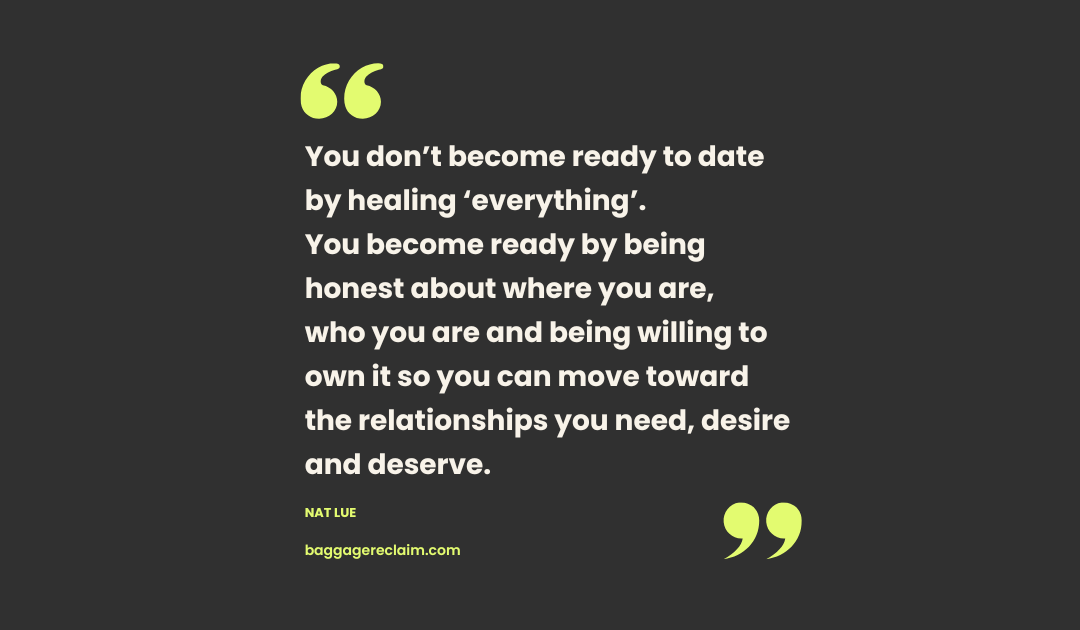
After 20 years of this work, I know dating readiness isn’t about how long it’s been since your last relationship ended. It’s about whether you’ve done the inner work to understand your part in why that relationship didn’t work or why you approached relationships and yourself in a painful way. Not to blame yourself, but to recognise your patterns and make different choices.
The people who struggle most aren’t the ones who waited “too long” or jumped in “too soon”—it’s what that time represented. They never asked: What was I avoiding by staying in that relationship? What am I trying to avoid by rushing into a new one? What was I avoiding by beating myself up or pining for so long?
Those questions tell you if you’re ready, not the calendar.If you have a good sense of who you are, you can trust yourself, are mindful and can take care of yourself, give dating a shot. There are no guarantees, of course. But you’ll be able to get a sense of whether something’s working for you. You’re in a much better place to find a relationship that’s actually befitting of you. Not sure where you’re at but want to date? Be prepared to listen to yourself and learn as you go. Be willing to opt out when needed.
The patterns that keep you stuck aren’t permanent; they’re just well-practiced. Break the Cycle helps you understand why you keep ending up in the same relationship with different people.
I’ve been running Baggage Reclaim since September 2005, and I’ve spent many thousands of hours writing this labour of love. The site has been ad-free the entire time, and it costs hundreds of pounds a month to run it on my own. If what I share here has helped you and you’re in a position to do so, I would love if you could make a donation. Your support is so very much appreciated! Thank you.
Copyright Natalie Lue 2005-2026, All rights reserved. Written and express permission along with credit is needed to reproduce and distribute excerpts or entire pieces of my work.
Manage Cookie Consent
To provide the best experiences, we use technologies like cookies to store and/or access device information. Consenting to these technologies will allow us to process data such as browsing behaviour or unique IDs on this site. Not consenting or withdrawing consent, may adversely affect certain features and functions.
Functional
Always active
The technical storage or access is strictly necessary for the legitimate purpose of enabling the use of a specific service explicitly requested by the subscriber or user, or for the sole purpose of carrying out the transmission of a communication over an electronic communications network.
Preferences
The technical storage or access is necessary for the legitimate purpose of storing preferences that are not requested by the subscriber or user.
Statistics
The technical storage or access that is used exclusively for statistical purposes.The technical storage or access that is used exclusively for anonymous statistical purposes. Without a subpoena, voluntary compliance on the part of your Internet Service Provider, or additional records from a third party, information stored or retrieved for this purpose alone cannot usually be used to identify you.
Marketing
The technical storage or access is required to create user profiles to send advertising, or to track the user on a website or across several websites for similar marketing purposes.